
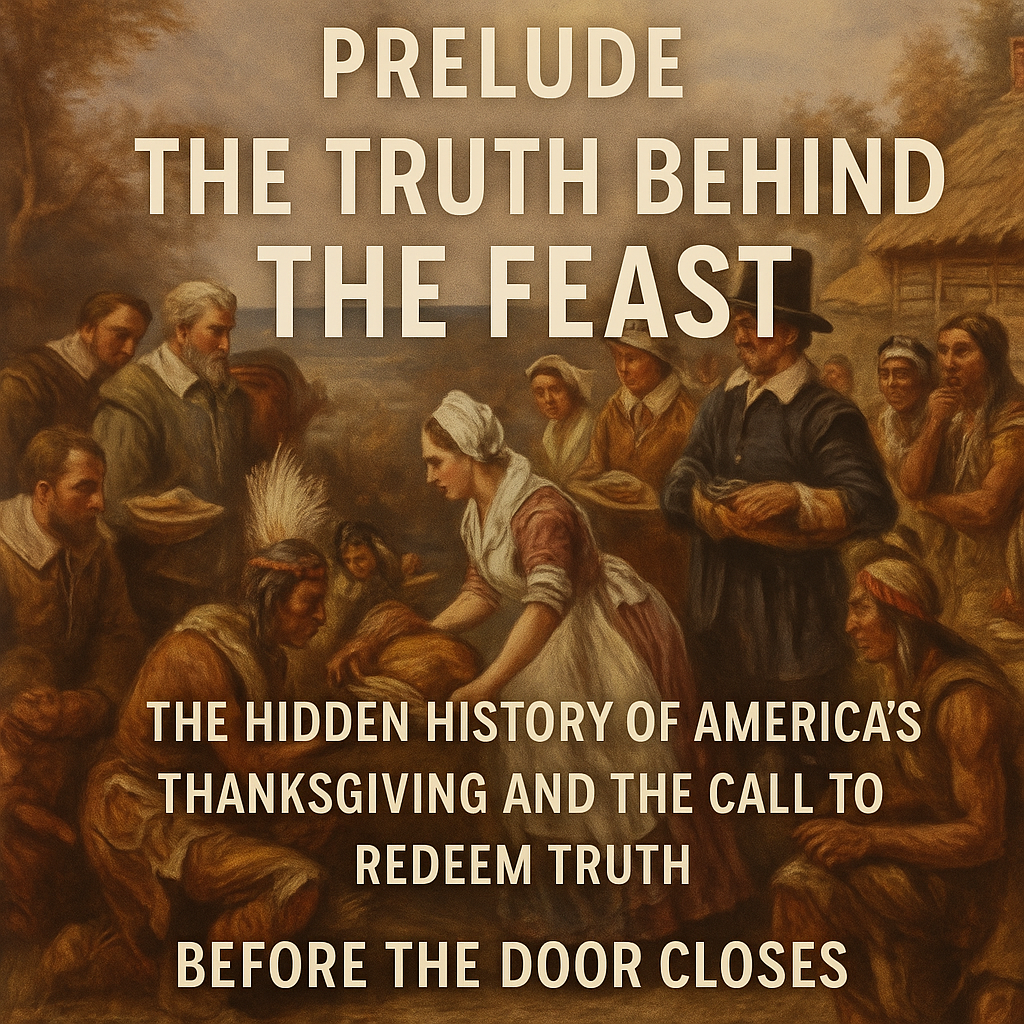
PRELUDE: THE TRUTH BEHIND THE FEAST – The Hidden History of America’s Thanksgiving and the Call to Redeem Truth Before the Door Closes
THE INVITATION TO TRUTH
Before a thing can be redeemed, it must be revealed.
Before a moment can be reclaimed for righteousness, its roots must be exposed.
This is not a story of condemnation — it is a call to discernment. It is not an attack against gratitude, but a confrontation with deception.
The day called Thanksgiving is one of America’s most beloved and least understood traditions. It is wrapped in warmth and nostalgia — family tables, autumn colors, and sentiments of unity. Yet beneath the fragrance of roasted turkey lies the stench of blood, politics, and pagan syncretism. What the world celebrates as sacred, Scripture exposes as mixed. What began as the worship of false gods, rebranded through empire and conquest, has been sanctified by national myth and sold as tradition.
If we, the remnant, are to redeem this day — to reach the world before the door closes — then we must first strip away its disguise and see it for what it truly is: a hybrid feast born of ancient idolatry, baptized in colonial conquest, and perpetuated through national pride.
This is the prelude. The unmasking before the awakening. The truth behind the feast.
ANCIENT ROOTS OF THANKSGIVING — THE PAGAN FOUNDATION
Thanksgiving is not an American invention. It is humanity’s oldest reflex — gratitude divorced from the covenant of the Creator.
In the earliest civilizations, men gave thanks not to Yahuah, but to the earth, the sun, the moon, and the gods of fertility and harvest. These were not holy convocations; they were ritual appeasements meant to guarantee survival.
Babylon
In ancient Babylon, offerings of grain, wine, and livestock were presented to Marduk, the god of order, and to Ishtar, goddess of fertility and war. Their festivals marked the turning of seasons and the filling of storehouses.
Egypt
The Egyptians offered firstfruits to Min, god of reproduction and vegetation. Public parades celebrated the flooding of the Nile — the lifeblood of their crops. Praise was given not to the Creator but to the cycle itself.
Greece and Rome
The Greeks honored Demeter and her daughter Persephone, whose descent into Hades and return to the surface symbolized the death and rebirth of the land. The Romans mirrored this with Ceres, goddess of grain, and the festival of Cerealia — the same root from which we get “cereal.” Both included sacrifices, music, and feasts marking the end of harvest.
Celtic and Druidic Europe
The Celts held Samhain at the end of the agricultural year — a mixture of thanksgiving, ancestor worship, and divination. Bonfires burned to honor spirits of the dead. Offerings were left at doorways for wandering souls. Gratitude mingled with fear and superstition.
All these harvest festivals share the same DNA: mankind worshiping creation instead of the Creator. The prophet Sha’ul (Paul) spoke directly to this condition:
“They exchanged the truth of Elohim for the lie, and worshiped and served the creation rather than the Creator, who is blessed forever.”
— Romans 1:25
This is the seed from which the world’s “thanksgiving” grew. It is gratitude without repentance. Worship without covenant. Religion without truth.
FROM ENGLAND TO THE NEW WORLD — THE PURITAN BLUEPRINT
By the time the Pilgrims crossed the Atlantic, these ancient rhythms had been baptized in Christian language. In 16th- and 17th-century England, Puritans held Days of Fasting (for repentance) and Days of Thanksgiving (for deliverance from drought, famine, or war). These were not Torah-appointed mo’edim — they were manmade observances declared by magistrates and ministers.
When the Puritans landed at Plymouth in 1620, they brought this tradition with them. After surviving starvation and disease, they held a harvest celebration in 1621 with the Wampanoag. It lasted three days — hunting, feasting, and diplomacy. It was not called Thanksgiving. There was no covenant renewal, no Torah commandment, no appointed time — only relief that they were alive.
Modern America has mythologized this meal into the “First Thanksgiving.” Schoolbooks paint it as the birth of national gratitude, a symbol of harmony between Pilgrims and natives. But it was a temporary truce, not a covenant of peace. Within a generation, those same settlers would wage wars of extermination against the very tribes that once fed them.
THE BLOOD-STAINED FEAST — THE PEQUOT MASSACRE (1637)
The true first official Thanksgiving in colonial America was not a feast of fellowship. It was a celebration of slaughter.
In May 1637, English Puritans from Massachusetts Bay and Connecticut, joined by Mohegan and Narragansett allies, surrounded a fortified Pequot village at Mystic, Connecticut. At dawn they attacked, setting fire to the settlement. Men, women, and children burned alive. Those who fled the flames were shot. Between 400 and 700 Pequot were killed — most of them women and children.
Governor John Winthrop recorded the event and proclaimed that the colonists should give thanks to God for their victory over the “heathen.”
Minister Increase Mather called it “a sweet sacrifice” and praised the Lord who had “delivered the enemy into our hands.”
On May 26, 1637, the colony of Massachusetts Bay declared a Day of Thanksgiving.
The first thanksgiving proclamation in the New World was not for harvest or peace, but for massacre.
They sang hymns over ashes.
They blessed the God of war for victory in blood.
The following year, the Treaty of Hartford (1638) outlawed the Pequot name itself. Survivors were enslaved, scattered, or executed. The tribe was declared extinct — and a tradition of thanksgiving for conquest was born.
Thus began America’s cycle of national amnesia: calling blood “blessing,” and conquest “providence.”
It was religion without repentance — theology used to baptize genocide.
A NATION REBRANDED — THANKSGIVING AS CIVIL RELIGION
Over a century later, in 1789, George Washington proclaimed the first national day of thanksgiving, giving thanks for “tranquility, union, and civil liberty.” His motive was political unity, not covenantal repentance. It was a gesture of national identity, not obedience to Torah.
In 1863, during the Civil War, Abraham Lincoln reestablished the tradition. His proclamation called citizens to thank “our beneficent Father who dwelleth in the Heavens,” even while the nation was bleeding. It was a brilliant act of statesmanship — a religious veneer to bind a divided people.
Gratitude became a tool for national healing, not a call to righteousness. A holy-sounding civil religion was born.
Finally, in 1941, Franklin D. Roosevelt signed legislation fixing Thanksgiving as the fourth Thursday of November — officially linking gratitude with consumerism. By mid-century, the day had become the commercial gateway to the Christmas shopping season.
The feast that began with fire and blood ended with parades and football.
THE PAGAN AND SECULAR OVERLAY
Even its imagery betrays its pagan roots.
The cornucopia, or “horn of plenty,” is borrowed directly from Greek mythology.
The harvest motifs of wheat, gourds, and pumpkins mirror the fertility symbols of ancient Europe.
The timing — the late autumn harvest — aligns not with any appointed feast of Yahuah but with the agricultural cycle of pagan nations.
Even the modern gluttony and entertainment echo Rome’s Saturnalia — the feast of excess that mocked restraint.
For Native Americans, the holiday remains a wound.
Since 1970, many have observed Thanksgiving as a National Day of Mourning, gathering at Plymouth to honor ancestors lost to colonization and disease.
Their remembrance exposes what the nation has long concealed: that America’s table was built atop stolen land and spilled blood.
THE NATIONAL MYTH
Empires sanctify their histories. America is no exception.
The sanitized “Pilgrim and Indian feast” became a national origin story — a parable of peace that hides a pattern of conquest.
From school plays to church sermons, the narrative trains generations to thank God for abundance while ignoring injustice.
But the Scriptures are not silent:
“Bring no more vain offerings; incense is an abomination to Me.
Your new moons and appointed feasts My soul hates; they are a burden to Me; I am weary of bearing them.”
— Isaiah 1:13–14
When a nation lifts hands in thanksgiving while its foundations drip with blood, Yahuah does not hear the songs — He hears the cries of the slain.
A HEBRAIC RESPONSE — TRUE THANKSGIVING RESTORED
The Torah defines thanksgiving (todah) not as a day, but as a life of obedience.
It is the natural outflow of covenant relationship, not the ritual of a calendar.
Leviticus 7:12 describes the zevach todah — the thanksgiving offering presented after deliverance. It was eaten the same day, never hoarded, signifying dependence on Yahuah.
Psalm 50:23 declares:
“He who offers thanksgiving as his offering honors Me, and to him who orders his way rightly I show the deliverance of Elohim.”
The Hebraic mind understands that gratitude is holy only when it springs from obedience.
It is not bound to a date on a Roman calendar; it is bound to the rhythm of the Creator’s covenant.
To the world, thanksgiving is a season.
To the Kingdom, thanksgiving is a posture of life.
Thus the question is not whether believers should give thanks — it is to whom, how, and why.
Do we feast to honor our Creator, or to imitate the nations?
Do we gather to glorify Elohim, or to preserve a cultural myth?
Do we bless the harvest, or the One who gives seed to the sower?
True thanksgiving is not turkey, parade, and football — it is repentance, recognition, and restoration.
PROPHETIC REFLECTION — THE HOUR IS LATE
The time of the Gentiles is closing.
The kingdoms of this world are being weighed, and the remnant is being refined.
Every counterfeit feast is being exposed. Every false altar is being shaken.
Yahuah is calling His people to discernment — to separate gratitude from idolatry, tradition from truth.
We do not reject gratitude — we reclaim it.
We do not boycott the table — we sanctify it.
We do not hide from the world — we enter it bearing light.
But we must not lie to ourselves: what began in blood cannot be sanctified by sentiment. Only truth redeems.
Let every believer understand the cost of this holiday and the deception it conceals. Let every watchman sound the trumpet against cultural compromise. Let the remnant return to the feasts of Yahuah — the true appointed times that point to covenant, deliverance, and restoration.
TRANSITION INTO THE SERIES
This introduction sets the foundation for what follows in The Truth Behind the Feast series — revealing the deception of man-made gratitude and calling the remnant back to covenant truth through restoration, obedience, and engagement.
Part I – The Roots of the Feast: From Puritans to Presidents
Uncovering the civil, religious, and political origins of America’s “Thanksgiving” — from English Puritan days of fasting and prayer to colonial survival feasts, from presidential proclamations to the invention of a national myth. This part exposes how a civic ritual of gratitude replaced the commanded mo’edim of Yahuah and how Sukkot, the true harvest feast, was displaced by human tradition. It establishes the historical foundation that every later revelation builds upon.
Part II – The Counterfeit Harvest
Reveals how mankind replaced covenant gratitude with cultural religion. This section traces the transition from Hebraic obedience to Western civil ritualism, showing how idolatry disguised as “thankfulness” seduced nations into self-worship. It dissects the philosophies, church traditions, and political manipulations that turned thanksgiving from worship into nationalism and commerce — the false harvest that feeds pride rather than praise.
Part III – The True Thanksgiving (Sukkot)
Restores the original, commanded Feast of Rejoicing. This part walks through Torah’s pattern of the Feast of Ingathering, unveiling its prophetic picture of the Kingdom to come and the dwelling of Elohim with His people. It contrasts the joy of obedience with the emptiness of imitation, demonstrating that the only true thanksgiving is found in the presence of Yahuah during His appointed times. Here, gratitude is not seasonal — it is covenantal.
Part IV – Covenant Gratitude Restored
Calls the remnant back to the posture of thanksgiving defined by Torah and demonstrated by the prophets, psalmists, and emissaries of Yahusha. It details how repentance restores right worship and how obedience renews intimacy with the Creator. This section provides the framework for returning to the rhythm of gratitude that honors Yahuah daily — through humility, sacrifice, and steadfast faith — setting the heart of worship back in order.
Part V – The Family Table
Shows how to redeem gatherings through Kingdom witness. This part brings the teaching home — literally. It instructs parents, leaders, and disciples how to sanctify the table, how to transform routine meals into teaching moments, and how to model holiness within family circles without pride or compromise. The Family Table becomes a microcosm of the Kingdom: a place of peace, testimony, and covenant remembrance where generations learn to give thanks rightly.
Part VI – The Watchman’s Charge
Issues the prophetic call to engage the world before the door closes. This section empowers the remnant to stand as sent ones — guardians of truth, proclaimers of light, and witnesses of the coming Kingdom. It challenges complacency and confronts lawlessness, teaching that gratitude must produce obedience and that watchmen are accountable for the truth they withhold. The Watchman’s Charge transforms knowledge into mission.
Final Chapter – Redeeming the Moments: Reaching the World Before the Door Closes
Converts revelation into action. This closing chapter equips believers to carry truth into their homes, communities, and public life with uncompromised witness. It is the operational manual for engagement — how to live holy within an unholy world, how to sit at the world’s tables without partaking in its idolatry, and how to redeem every encounter as a divine appointment. It sends the remnant forth with clarity, courage, and covenant purpose.
Each part builds upon the revelation that gratitude without covenant is empty, and that the people of Elohim must reclaim what the world has corrupted. The series begins with exposure, moves through restoration, and ends with activation — preparing the remnant to redeem every moment before the door closes.
FINAL WORD
Thanksgiving, as the world knows it, was born in conquest, rebranded in politics, and crowned by commerce.
It carries the DNA of every false feast before it — a mixture of truth and deception, of gratitude and rebellion.
Yet Yahuah still calls His people to true thanksgiving: gratitude anchored in obedience, worship grounded in truth, and fellowship sanctified by covenant.
We cannot redeem what we will not expose.
We cannot transform what we refuse to confront.
We cannot reach the world if we do not understand the world’s deception.
So before the next feast begins — before the next family prayer is uttered over a table built on myth — let the watchman rise.
Let him tell the truth.
Let him shine the light.
Let him call the people back to the appointed feasts of the King.
“Give thanks to Yahuah, for He is good; His mercy endures forever.”
— Psalm 118:1
#EphraimsCry, #GregWitter, #HebraicMindsetStudySeries, #HebraicMindset, #StudyLearnApplyGrowShareRepeat, #TruthBehindTheFeast, #ThanksgivingExposed, #PaganRootsRevealed, #CivilReligionUnmasked, #PuritanHistory, #PequotMassacre, #NationalMyth, #RedeemTheTable, #CovenantGratitude, #ReturnToTorah, #SukkotTruth, #WatchmanWarning, #PropheticDiscernment, #EndTimeDeception, #ScriptureOverTradition, #ExposeTheLie, #RemnantRising, #LawlessnessExposed, #RedeemingTheMoments, #TruthInScripture, #BibleTruth, #ScriptureStudy, #EndTimes, #WatchmanOnTheWall, #Remnant, #Faith, #Kingdom, #Torah, #Prophecy
