
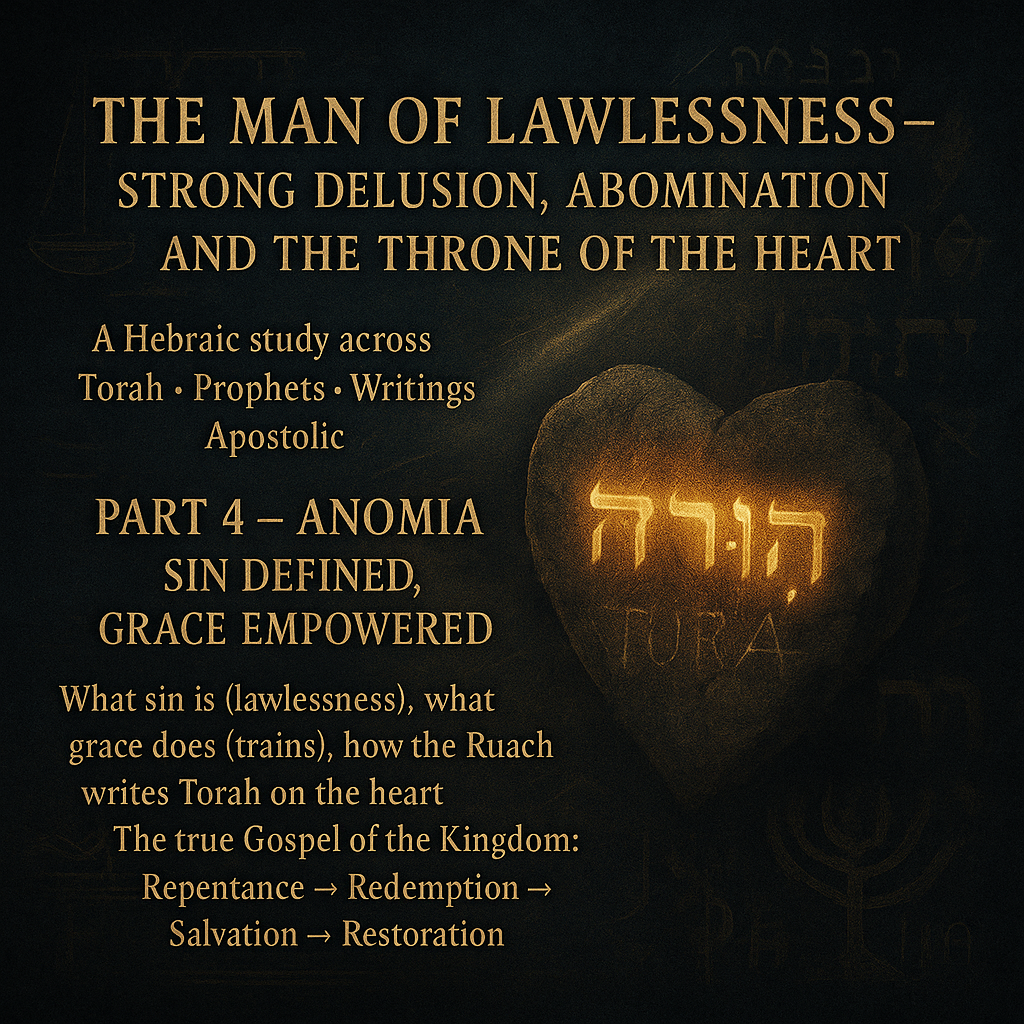
THE MAN OF LAWLESSNESS — STRONG DELUSION, ABOMINATION, AND THE THRONE OF THE HEART
A Hebraic study across Torah • Prophets • Writings • Apostolic
PART 4 — ANOMIA — SIN DEFINED, GRACE EMPOWERED
What sin is (lawlessness), what grace does (trains), how the Ruach writes Torah on the heart • The true Gospel of the Kingdom: Repentance → Redemption → Salvation → Restoration
Greg Witter
Ephraim’s Cry | Hebraic Mindset Study Series
Study • Learn • Apply • Grow • Share • Repeat
Orientation
Anomia (lawlessness; ah-NO-mee-ah; anti-Torah) is Scripture’s blunt definition of sin (1 John 3:4). Hamartia (sin; hah-mar-TEE-ah; missing the mark) describes sin’s effect, but the mark itself is Torah (instruction; toh-RAH; Paleo pictograph: Tav–Vav–Resh–Hey = sign • hook • head • behold)—Yahuah’s righteous standard (Psalm 119:142; Romans 7:12). Charis (grace/favor; KHAH-ris) never erases Torah; it trains to deny ungodliness and live uprightly (Titus 2:11–14). The Ruach (ROO-akh; Spirit) indwells to cause us to walk in Yahuah’s statutes (Ezekiel 36:26–27) so that “the righteous requirement of the Torah might be fulfilled in us who walk according to the Spirit” (Romans 8:4).
We will also trace the Gospel of the Kingdom—Repentance → Redemption → Salvation → Restoration—through the Four Witnesses and then lay down a lived Rule of Life.
I. TORAH (FIRST WITNESS): WHAT SIN IS, HOW IT’S DEALT WITH
Torah is the Creator’s plumb line. It defines sin precisely, distinguishes ignorance from willful revolt, requires restitution, and schools a people through rhythms of time (Shabbat, moedim). It proves the target we “miss” is His instruction, not feelings or fashion.
1) Sin Identified and Weighed
Torah diagnoses sin and prescribes responses that fit the offense.
• Unintentional vs. high-handed: offerings for inadvertent sin; cut off for the one who sins “with a high hand” (Numbers 15:27–31).
• Just measures: cheating weights are abomination (Leviticus 19:35–36; Deuteronomy 25:13–16).
• Restitution: wrongs require repayment plus a fifth (Leviticus 6:1–7).
2) Holiness Rhythms that Shape Life
Yahuah trains loyalty by weekly and seasonal pedagogy.
• Shabbat as sign of sanctification/ownership (Exodus 31:13–17; Ezekiel 20:12, 20).
• Moedim (appointed times; mo-eh-DEEM) rehearse redemption, discipline desire (Leviticus 23).
• Word near you—you can do it (Deuteronomy 30:11–14).
3) Gospel-of-the-Kingdom Pattern in Torah
Torah sketches the Kingdom sequence later preached by Yahusha.
• Repentance — teshuvah (teh-shoo-VAH; return): “When you return… and obey His voice” (Deuteronomy 30:1–3).
• Redemption — geulah / go’el (g’oo-LAH / go-EL; ransom/redeemer): “I will redeem you with an outstretched arm” (Exodus 6:6; Leviticus 25).
• Salvation — yeshuah (yeh-SHOO-ah; deliverance): “See the salvation of Yahuah” (Exodus 14:13).
• Restoration — berit (beh-REET; covenant) communion: “A kingdom of priests” (Exodus 19:4–6).
Torah line: Sin = violation of Yahuah’s commands; cure = return + restitution + renewed obedience in His holy rhythms; Kingdom sequence = return → ransom → rescue → renewed covenant.
II. PROPHETS (SECOND WITNESS): TURN, AND LIVE
The Prophets reject cosmetic religion. They summon heart-level turning and promise Spirit power to walk. Grace and obedience are covenant twins, not rivals; the Prophets preach the Kingdom pattern ahead of time.
1) Heart Circumcision & Spirit Power
Turning is empowered from within, not staged from without.
• “I will put My Spirit within you and cause you to walk in My statutes” (Ezekiel 36:26–27).
• “I will put My Torah within them and write it on their hearts” (Jeremiah 31:31–34).
2) Real Repentance, Not Ritual Posing
Repentance is ethical, practical, text-defined.
• “Wash… cease to do evil; learn to do good” (Isaiah 1:16–17).
• “Return to Yahuah… take with you words” (Hosea 14:1–2).
• “Seek Yahuah… forsake wicked ways… He will abundantly pardon” (Isaiah 55:6–7).
3) Redemption — Yahuah the Go’el
The Prophets name Yahuah as Redeemer who reclaims people and land.
• “A Redeemer will come to Zion” (Isaiah 59:20; cf. 41:14; 43:1).
4) Salvation — Deliverance Declared
The Servant secures peace by bearing iniquity.
• “How beautiful… who proclaims salvation” (Isaiah 52:7); Isaiah 53.
5) Restoration — Covenant Renewal by the Ruach
Restoration is Torah-on-hearts and Spirit-enabled walking.
• Jer 31:31–34; Ezek 36:26–27; “Raise up the booth of David” (Amos 9:11–12).
Prophets line: The Ruach doesn’t license anomia; He breaks it—writing Torah within and empowering obedience without. Kingdom flow = repent → redeem → save → restore.
III. WRITINGS (THIRD WITNESS): DESIRE TRAINED, DEEDS ORDERED
The Writings catechize love and habit. Meditation forms the forehead; wise practices train the hand. The fourfold path is lived in songs and proverbs—own sin, return, receive mercy, walk renewed.
1) Torah as Delight and Guardrail
Meditation both delights and restrains.
• “Delight… meditates day and night” (Psalm 1:2).
• “Your word I’ve hidden in my heart” (Psalm 119:11; cf. 119:97–105).
• “Torah… perfect, restoring the soul” (Psalm 19:7–14).
2) Repentance that Restores
Honest confession unlocks mercy and obedience.
• “He who confesses and forsakes will obtain mercy” (Proverbs 28:13).
• Psalms 32 & 51: admitted sin → cleansing → willing obedience.
3) Redemption & Salvation Celebrated
Worship names the Redeemer and the Rescue.
• “With Him is abundant redemption” (Psalm 130:7–8).
• “Yahuah is my salvation” (Psalm 27:1).
Writings line: Worded meditation + honest repentance re-train love and works; lived Gospel = teshuvah → geulah → yeshuah → covenant delight.
IV. APOSTOLIC WRITINGS (FOURTH WITNESS): ANOMIA REJECTED, GRACE THAT TRAINS • KINGDOM GOSPEL DECLARED
The Apostolic witness defines sin, restores charis as training power, centers Yahusha as the pattern of obedient love, and proclaims the Gospel of the Kingdom.
1) Sin Defined, Workers Identified
The apostolic line is unambiguous.
• “Sin is anomia” (1 John 3:4).
• “Depart from Me, workers of anomia” (Matthew 7:21–23).
2) Grace as Trainer, Not Permit
Grace changes people; it doesn’t excuse us.
• “Charis… training us… zealous for good works” (Titus 2:11–14).
• “Do we nullify Torah by faith? By no means! We establish Torah” (Romans 3:31).
3) Spirit-Enabled Obedience
The New Covenant walk is Spirit-powered.
• “Righteous requirement of Torah fulfilled in us who walk by the Spirit” (Romans 8:4).
• “If you love Me, keep My commands” (John 14:15; cf. 15:10).
• “What matters is keeping the commandments of Elohim” (1 Corinthians 7:19).
• Faith that works (James 2:14–26); grace → workmanship (Ephesians 2:8–10).
4) Gospel of the Kingdom — Euangelion of the Basileia
The message order is fixed.
• “Repent, for the Kingdom is at hand” (Matthew 4:17; Mark 1:14–15).
• “Repentance and forgiveness proclaimed” (Luke 24:47; Acts 2:38; 3:19).
5) Redemption Secured in Messiah
The ransom is blood-bought.
• “In Him we have redemption through His blood” (Ephesians 1:7; Colossians 1:13–14; 1 Peter 1:18–19).
• “Messiah redeemed us from the curse of the law” (Galatians 3:13)—i.e., Torah’s penalty for disobedience (Deuteronomy 27–30), not Torah itself.
6) Salvation from the Law of Sin and Death
Deliverance is transfer of rule.
• “Law of the Spirit of life… set you free from the law of sin and death” (Romans 8:2; cf. Acts 4:12).
7) Restoration to Covenant Relationship
Love is defined by obedience.
• John 14:15; 15:10; Romans 3:31; Acts 15:15–17 (Amos 9).
Apostolic line: Anomia is out; charis trains; Ruach empowers; Yahusha models obedient love. Kingdom Gospel = Repent → Redeemed → Saved → Restored.
V. WORDWORK — FIRST-USE GLOSSES (FOR BEGINNERS)
Clarity blocks counterfeits; first uses carry plain English + sound-out.
• Anomia (ἀνομία) — lawlessness; anti-Torah (ah-NO-mee-ah)
• Hamartia (ἁμαρτία) — sin; missing the mark (hah-mar-TEE-ah)
• Charis (χάρις) — grace/favor; empowering/training gift (KHAH-ris)
• Metanoia (μετάνοια) — repentance; turning mind/way (meh-tah-NOY-ah)
• Pistis (πίστις) — faith/loyalty/faithfulness (PIS-tis)
• Dikaiosynē (δικαιοσύνη) — righteousness/justice (dee-kai-oh-SOO-nay)
• Ruach (רוּחַ / πνεῦμα) — Spirit/wind/breath (ROO-akh)
• Teshuvah (תשובה) — repentance/return (teh-shoo-VAH)
• Geulah / Go’el (גְּאֻלָּה / גֹּאֵל) — redemption / redeemer (g’oo-LAH / go-EL)
• Lutrōsis (λύτρωσις) — redemption/ransom (loo-TROH-sis)
• Yeshuah (יְשׁוּעָה) — salvation/deliverance (yeh-SHOO-ah)
• Sōtēria (σωτηρία) — salvation (so-teh-REE-ah)
• Berit / Diathēkē (בְּרִית / διαθήκη) — covenant (beh-REET / dee-ah-THEY-kay)
• Euangelion (εὐαγγέλιον) — good news/gospel (yoo-ahn-GEL-ee-on)
• Basileia (βασιλεία) — kingdom/reign (bah-see-LAY-ah)
VI. THEOLOGY OF GRACE & OBEDIENCE — HOW THEY FIT
Grace is power to live loyal. Order: Redeemed by favor → Indwelt by Ruach → Walk in commandments (Exodus 20:2 precedes 20:3–17; Titus 2:11–14; Ezekiel 36:27). Faith establishes Torah (Romans 3:31) and refuses anomia (1 John 3:4). Yahusha kept the Father’s commands and calls us into the same love (John 15:10).
• Pattern: Redemption → Identity → Instruction → Practice.
• Axis: Forehead (renewed mind) + Hand (trained deeds).
• Proof: Fruit of the Spirit vs. works of the flesh (Galatians 5:19–23); workers of anomia rejected (Matthew 7:23).
VI-B. THEOLOGY OF GRACE, KINGDOM, & OBEDIENCE — HOW THEY INTERLOCK
Grace empowers loyalty inside the Kingdom sequence: Repent → Redeem → Save → Restore (Exodus pattern; Jer 31:31–34; Ezek 36:26–27; Titus 2:11–14; Rom 3:31; 8:4).
• Pattern (expanded): Out of bondage → Covenant given → Presence indwelling → Obedience walked.
• Axis: Forehead + Hand.
• Proof: Fruit vs. flesh; allegiance measured in worship and works.
VII. PRACTICAL RULE OF LIFE — GRACE THAT TRAINS (FOREHEAD & HAND)
We live the Kingdom rhythm daily/weekly/seasonally: Repentance → Redemption → Salvation → Restoration.
Forehead (mind/loyalty):
• Daily Shema (Deut 6:4–9; 11:18–21) + Psalm 1/119 rotation.
• Repentance drill (metanoia): name the sin by command, confess, forsake, replace with three Scriptures; rehearse 7 days (Prov 28:13; Ps 119:11).
• Truth fast: one day/week off propaganda; fill with Four-Witness study on one theme.
• Kingdom confession: Mark 1:15; Romans 10:9–10; Revelation 14:12.
Hand (works/practice):
• Shabbat sign with delight practices (Isa 58:13–14; Ex 31:13–17).
• Honest weights audit (Prov 11:1; Mic 6:10–12).
• Justice-mercy weekly acts (Mic 6:8); track & testify (Matt 5:16).
• Speech holiness plan (Eph 4:25–32).
• Baptism / Table as embodied repentance & redemption memorials (Acts 2:38; 1 Cor 11:23–26).
Household / Ekklesia:
• Table liturgy: Word, testimony, prayer, priestly blessing (Num 6:24–26).
• Gate-guard: remove pharmakeia/occult/porn (Eph 5:3–12; Acts 19:19).
• Discipline with restoration (Matt 18:15–17; Gal 6:1).
VIII. DIAGNOSTICS — ARE WE TRAINED BY GRACE OR TOLERATING ANOMIA?
Diagnostics are mercy; alignment is the goal (1 Cor 11:31).
Personal:
• Do I define sin by Torah, not culture (1 Jn 3:4; Rom 7:12)?
• Is there observable training in me (Titus 2:11–14)?
• Are works of the flesh shrinking, fruit growing (Gal 5:19–23)?
Assembly (ekklesia):
• Do leaders distinguish holy/common, clean/unclean (Ezk 22:26; 44:23)?
• Is discipline practiced unto restoration (1 Cor 5; 2 Thess 3:6; Gal 6:1)?
• Shepherding or merchandising (Jn 10; 2 Pet 2:3)?
VIII-B. DIAGNOSTICS — KINGDOM GOSPEL OR COUNTERFEIT?
Personal:
• Is repentance regular and observable (Acts 3:19)?
• Do I trust the Redeemer and walk in prepared good works (Eph 1:7; 2:10)?
• Am I walking free by the law of the Spirit of life (Rom 8:2)?
• Is my week restored to covenant rhythms (Lev 23; Isa 58:13–14)?
Assembly:
• Do elders distinguish holy/common (Ezk 22:26; 44:23)?
• Do we teach Repent → Redeem → Save → Restore, or a reduced message?
IX. GUARDRAILS — TESTING “GRACE” & “GOSPEL” MESSAGES
Not every “grace” is charis; not every “gospel” is euangelion. Test by Scripture and fruit.
• Does it train denial of ungodliness and zeal for good works (Tit 2:11–14)?
• Does it establish Torah (Rom 3:31)?
• Does it honor Yahusha’s word: “If you love Me, keep My commands” (Jn 14:15; 15:10)?
• Does it start with repentance (Mk 1:15; Lk 24:47; Acts 2:38)?
• Does it center blood redemption (Eph 1:7; 1 Pet 1:18–19)?
• Does it announce salvation from sin/death (Rom 8:2; Acts 4:12)?
• Does it restore to covenant obedience by the Ruach (Jer 31:33; Ezk 36:27; Rom 8:4)?
X. COMMON OBJECTIONS — TEXT-FIRST ANSWERS
We answer plainly from Scripture, inviting teshuvah.
“We’re not under law but under grace.”
Rom 6:14 addresses sin’s dominion, not Torah’s goodness; grace makes us obedient (Rom 6:15–18).
“Yahusha fulfilled the law, so we don’t keep it.”
“Fulfill” ≠ “abolish” (Matt 5:17–19). He forbids loosening the least command and Himself keeps the Father’s commands (Jn 15:10).
“Commandments are for Jews only.”
“One Torah for native and sojourner” (Ex 12:49; Num 15:15–16). Isaiah 56 welcomes foreigners who keep Sabbath and covenant. Ekklesia is one new man (Eph 2:11–22).
“Obedience is legalism.”
Legalism = trusting law to justify. Obedience = fruit of redemption: charis trains (Tit 2:11–14); faith establishes Torah (Rom 3:31).
XI. RECOVERY PATH — TESHUVAH & RE-ENTHRONEMENT
When the mirror convicts, move. Metanoia (meh-tah-NOY-ah) is turning into Yahusha’s easy yoke (Matt 11:28–30) where the Ruach empowers the walk (Rom 8:4).
-
Confess & forsake named sins by command (Prov 28:13; 1 Jn 1:9).
-
Re-order time with Shabbat/moedim (Ex 31; Lev 23).
-
Rebuild the Word-table at home (Deut 6:4–9).
-
Repair wrongs with restitution where possible (Lev 6:1–7).
-
Re-bind community discipline toward restoration (Matt 18; Gal 6:1).
-
Remain—abide in Yahusha’s love by keeping His commands (Jn 15:10).
XI-B. RECOVERY PATH — FROM ANOMIA TO THE KINGDOM WAY
Walk the fourfold order as habit.
-
Repentance: confess/forsake (Prov 28:13; 1 Jn 1:9; Acts 3:19).
-
Redemption: trust Messiah’s blood; receive forgiveness/adoption (Eph 1:7; Rom 8:15).
-
Salvation: renounce law of sin/death; step into Spirit-led life (Rom 8:2–4).
-
Restoration: keep His commands in covenant rhythms (Jn 14:15; Matt 23:23; Lev 23).
XII. CONSECRATION — GRACE TO OBEY
“Father, I reject anomia and embrace Your Torah as good (Rom 7:12).
Write it on my heart (Jer 31:33); fill me with Your Ruach to cause me to walk (Ezk 36:27).
Train me by charis (Tit 2:11–14).
Let the righteous requirement of the Torah be fulfilled in me as I walk by the Spirit (Rom 8:4).
In Yahusha’s Name. Amein.”
XII-B. CONSECRATION — THE KINGDOM GOSPEL PRAYER
“I repent—I return (Deut 30:2; Acts 3:19).
Through Yahusha’s blood, redeem me and forgive me (Eph 1:7).
Save me from sin and death (Rom 8:2).
Restore me to covenant fidelity—write Torah on my heart; put Your Ruach within me; cause me to walk (Jer 31:33; Ezk 36:27).
Amein.”
Word Glossary (first-use recap)
Anomia — lawlessness; anti-Torah (ah-NO-mee-ah) • Hamartia — sin; missing the mark (hah-mar-TEE-ah) • Charis — grace/favor that trains (KHAH-ris) • Metanoia — repentance (meh-tah-NOY-ah) • Pistis — faith/loyalty (PIS-tis) • Dikaiosynē — righteousness/justice (dee-kai-oh-SOO-nay) • Ruach — Spirit (ROO-akh) • Teshuvah — repentance/return (teh-shoo-VAH) • Geulah/Go’el — redemption/redeemer (g’oo-LAH / go-EL) • Lutrōsis — ransom (loo-TROH-sis) • Yeshuah — salvation (yeh-SHOO-ah) • Sōtēria — salvation (so-teh-REE-ah) • Berit/Diathēkē — covenant (beh-REET / dee-ah-THEY-kay) • Euangelion — gospel (yoo-ahn-GEL-ee-on) • Basileia — kingdom (bah-see-LAY-ah)
Hashtags
#EphraimsCry #GregWitter #HebraicMindsetStudySeries
#Remnant #HebraicMindset #Messianic #HebrewRoots #TorahPursuant #Ekklesia #Watchmen #Seekers #SetApart #CommandmentKeepers
#Anomia #GospelOfTheKingdom #Repentance #Redemption #Salvation #Restoration #Charis #Metanoia #Pistis #Dikaiosyne #FourWitnesses #Romans331 #Romans84 #Titus2 #Matthew7 #1John3 #Acts238 #Acts319 #ShabbatSign #ReturnToTorah #CommandsAndFaith #Naos #EndureToTheEnd
