
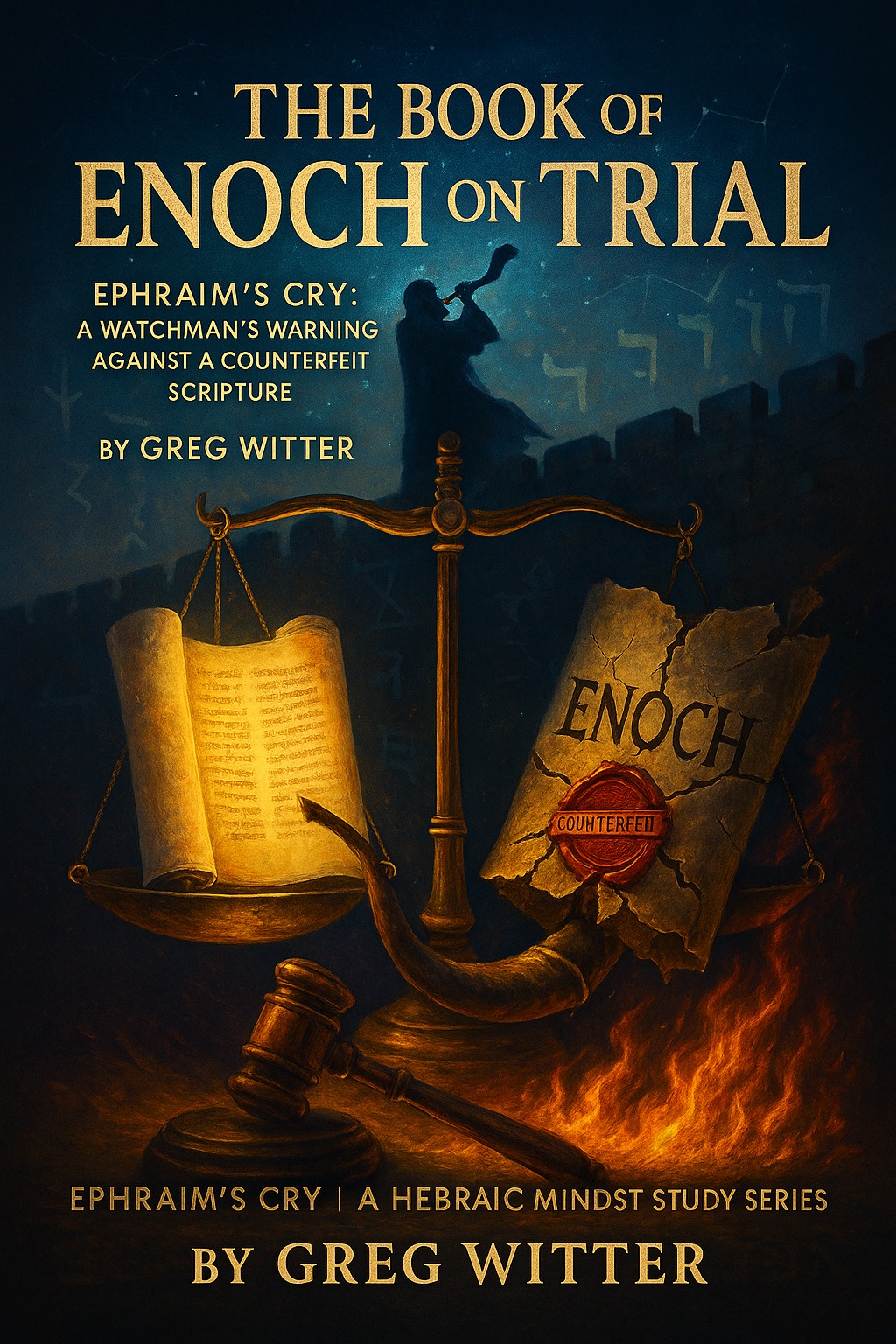
The Book of Enoch on Trial
Ephraim’s Cry: A Watchman’s Warning Against a Counterfeit Scripture
By Greg Witter
Ephraim’s Cry | A Hebraic Mindset Study Series
The shofar must be clear. When false light creeps toward the tents of Israel, when a counterfeit cloaks itself in the name of a patriarch to borrow holiness it does not have, the watchman is not permitted to whisper—he must sound the alarm. The lie has reared its ugly head once again. The deception of Satan, long condemned and cast out, has crept back into the camp. It has slithered its way into the Ekklesia, poisoning the minds of the unstable and running rampant among the undiscerning. That poison is the so-called Book of Enoch.
It is dressed in ancient clothes and perfumed with mystery. It promises “hidden knowledge,” whispers of “suppressed truth,” and the thrill of a shortcut to understanding the supernatural. But peel away the disguise and you will not find Scripture. You will find pseudepigrapha—false writings forged under a borrowed name, woven together long after the real Enoch “walked with Elohim and was not, for Elohim took him.”
This is not harmless curiosity. This is a test from Yahu’ah Himself. The Torah warned us plainly:
- “You shall not add to the word which I command you, nor take away from it, that you may keep the commandments of Yahu’ah your Elohim which I command you.” (Deuteronomy 4:2)
- “Whatever I command you, be careful to observe it; you shall not add to it nor take away from it.” (Deuteronomy 12:32)
- “If there arises among you a prophet or a dreamer of dreams, and he gives you a sign or a wonder… saying, ‘Let us go after other gods’—you shall not listen to that prophet or dreamer. For Yahu’ah your Elohim is testing you to know whether you love Yahu’ah your Elohim with all your heart and with all your soul.” (Deuteronomy 13:1–3)
- “When a prophet speaks in the name of Yahu’ah, if the thing does not happen or come to pass, that is the thing which Yahu’ah has not spoken; the prophet has spoken it presumptuously; you shall not be afraid of him.” (Deuteronomy 18:22)
The Book of Enoch is exactly such a test. It adds where Yahu’ah has not spoken. It subtracts where Yahu’ah has spoken clearly. It proclaims lying wonders, false prophecies, and doctrines of demons. And it tests whether the people of Elohim will follow His Torah and the testimony of Yahusha—or whether they will be seduced by counterfeits that glitter with mystery but reek of corruption.
Make no mistake: this is not a polite review. This is a trial. The Book of Enoch is on the stand. And the standard is the same old, steady measure that has preserved the Word from the beginning: the Four A’s—Authorship, Authenticity, Accuracy, and Authority. If a book fails here, it fails entirely. And the Book of Enoch fails on every count.
- Authorship — The Borrowed Name of a Righteous Man
When false light creeps back into the tents of Israel, when a counterfeit slips on the name of a patriarch to borrow holiness it does not have, the watchman cannot stay silent. He must sound the alarm. The so-called Book of Enoch has reared its head again in the Ekklesia, dressed in ancient clothes and perfumed with mystery. It whispers of “hidden wisdom” and “secret knowledge,” of truths “the church suppressed.” It promises revelation, but what it delivers is poison — a pseudepigraphon (false writing) forged centuries after Enoch “walked with Elohim.” It is not harmless curiosity; it is an intrusion from the enemy, a test from Yahu’ah to see whether His people will cling to Torah or chase after forgeries. And by His Word, we are commanded not to add and not to take away (Deut. 4:2; 12:32). The Book of Enoch does both.
A Composite Masquerade
What people call “The Book of Enoch” is not one book, nor the voice of the seventh from Adam, but a layered anthology stitched together across centuries of Jewish apocalyptic speculation:
- The Book of the Watchers (chs. 1–36) — 3rd–2nd century BCE. Obsessed with fallen angels, forbidden unions, and corruption.
- The Astronomical Book / Book of Luminaries (chs. 72–82) — 3rd–2nd century BCE. Proposes Uriel’s rigid 364-day solar calendar, directly contradicting Torah’s lunar-solar moedim (Gen. 1:14; Ps. 104:19).
- The Book of Parables / Similitudes (chs. 37–71) — late 1st century BCE. Introduces a mysterious “Son of Man” figure. Crucially, this entire section is absent from all Qumran fragments, exposing its lateness.
- The Book of Dream Visions (chs. 83–90) — 2nd–1st century BCE. Allegories of Israel’s history written as “prophecy” after the fact.
- The Epistle of Enoch (chs. 91–108) — 1st century BCE–1st century CE. Exhortations and apocalyptic warnings stitched to the end.
This is not the testimony of Enoch; it is centuries of redaction, imagination, and political theology, all wearing the mask of a righteous patriarch. It begins with deception — and therefore cannot be born of the Spirit of Truth.
The Languages Betray the Forgery
Even more, the languages expose it as counterfeit. If Enoch truly wrote a book, it would have been in the earliest form of Hebrew — before Babel, before the scattering of tongues. Instead, the manuscripts we have tell a different story:
- Aramaic fragments from Qumran — 2nd century BCE copies, long after Enoch.
- Greek translations — later pieces circulating among Hellenized Jews.
- Ethiopic (Geʽez) manuscripts — the only full versions preserved, dated more than a thousand years after Enoch’s day.
That is not the chain of an inspired autograph; it is a chain of translations (Hebrew/Aramaic → Greek → Geʽez), none of which connect us to the antediluvian world. Unless one believes Enoch foresaw languages not yet created, the only conclusion is pseudepigrapha — false works clothed in a stolen name.
The Silence of Scripture
If this book truly carried the voice of Yahu’ah, where is the echo in His Word? From Moses to Malachi, the Torah, the Prophets, and the Writings never once cite it. The Psalms exalt Moses more than forty times; Enoch receives none. Yahusha quoted Torah, the Prophets, and the Psalms — never Enoch. The apostles built every doctrine on “It is written” — never on Enoch.
This silence thunders. Yahu’ah Himself closed the canon, and He did not permit this forgery to enter His Temple of truth.
“But Jude Quoted Enoch”
The most common defense is Jude 14–15: “Behold, Yahu’ah comes with ten thousands of His holy ones…” But this line is not born in Enoch. It is rooted in:
- Deuteronomy 33:2 — “Yahu’ah came from Sinai… from the midst of myriads of holiness.”
- Isaiah 66:15–16 — “Yahu’ah will come with fire… to render His anger with fury.”
Jude is standing on Torah and the Prophets. He acknowledges a known prophetic motif, one that circulated orally, one that Enoch himself may have once spoken. But citing a true line is not the same as canonizing a forged anthology.
Paul quoted Greek poets (Acts 17:28; Titus 1:12) without enthroning their writings. In the same way, Jude may affirm a single saying attributed to Enoch without giving divine authority to an entire book. To argue otherwise is to open the door to canonizing Homer and Hesiod simply because Paul cited them — a path of absurdity.
Historical Witnesses
The people entrusted with the oracles of Elohim never recognized Enoch as Scripture.
- Josephus (1st century CE) listed 22 sacred books. No Enoch.
- Philo (1st century CE) quoted the Torah constantly. Never Enoch.
- The Septuagint, the Greek Scriptures used by Yahusha and His apostles, excluded it.
- The Masoretic Text, guarded by Jewish scribes, excluded it.
- The Council at Yavneh (c. 90 CE), where the Hebrew canon was reaffirmed, excluded it.
- Early church fathers: Tertullian toyed with it; Jerome, Augustine, and Origen rejected it outright.
- Only in Ethiopia did it survive as a local curiosity — and regional tradition cannot outweigh the testimony of Israel, the Messiah, and the apostles.
The Final Verdict
If Enoch truly authored this book, he somehow wrote in languages unborn, quoted prophets not yet written, and adopted literary styles that would not exist for two millennia. That is not revelation — it is retrofit fiction.
The verdict is clear: the Book of Enoch is not by Enoch. It is a Second Temple anthology falsely wearing his name, betraying itself in its languages, silenced by Scripture, unrecognized by Yahusha, ignored by the apostles, and rejected by the guardians of the canon.
It is not canon. It is not Torah. It is not prophecy. It is the serpent’s counterfeit, a test to see whether we will hold fast to what is written — or be swept away by every “hidden” wind of doctrine.
- Authenticity — not of Israel, not of the covenant
“Ancient” does not equal “authentic.” The covenant people of Yahu’ah have never recognized Enoch as Scripture. The evidence is consistent and overwhelming.
1) The Dead Sea Scrolls do not canonize Enoch.
Yes, Qumran preserved Enoch fragments—11 Aramaic manuscripts (mostly from Cave 4). But these are scraps, not scrolls—perhaps 15–20% of the Ethiopic book. By contrast, Qumran preserved an almost complete Isaiah scroll. That contrast matters: Isaiah carried recognized weight; Enoch shows up as fragmentary reading material. More devastating: the most cited section today, the Book of Parables (37–71)—with its “Son of Man/Chosen One” language—is absent from Qumran. If the Essenes prized Enoch’s “messianic” Parables, where are they?
And remember the Qumran bookshelf: alongside biblical books, the community stored horoscopes (4Q186), incantations (4Q560), calendrical experiments, and a range of apocalypses. Ownership does not equal inspiration. I can own The Hobbit without preaching Bilbo on Shabbat. Qumran’s variety is not a stamp of validity.
2) Israel’s canon never admitted Enoch.
The Scriptures of Israel—Torah, Prophets, and Writings—were known and read. Josephus speaks of 22 sacred books (a way of counting the same books we call the Tanakh). Philo honors Torah and the Prophets but never cites Enoch. The rabbinic listings (e.g., Bava Batra 14b–15a) enumerate the canon; Enoch is missing. After the Temple’s destruction, the sages at Yavneh (c. 90 CE) preserved what Israel had always recognized. Enoch remained outside.
3) The Septuagint (LXX) and the Masoretic Text (MT)—the Scriptures used in the time of Yeshua and transmitted by Israel—do not contain Enoch. Only the Ethiopian church kept it in a regional canon—alongside church manuals and other non-inspired works. Interesting historically; decisive theologically? No.
4) Early church reception ends the conversation. A few early Christian writers (e.g., Tertullian) flirted with Enoch; the mainstream (e.g., Origen, Jerome, Augustine) rejected it as non-canonical. The pattern is clear: initial curiosity, final dismissal.
Authenticity verdict: Enoch is not covenant Scripture. Not preserved by Israel. Not embraced by the Messiah’s apostles. It sits outside the lamp of Torah and the Testimony.
III. Accuracy — where Enoch collides with Torah, the Prophets, and the Writings
If a text disagrees with Torah, it’s done. If it confuses Messiah, it’s dangerous. Enoch does both.
- A) It elevates angels beyond their God-given lane.
Enoch depicts angels forgiving sins, governing nations, and acting as quasi-divine administrators (see the judgment cycle of 1 Enoch 6–10; 9:1–4; 10:4–6). Scripture is explicit:
- Only Yahu’ah forgives sins. “I, even I, am He who blots out your transgressions.” (Isa 43:25; cf. Ex 34:6–7; Ps 103:3; Mic 7:18–19)
- Angels reject worship. When John bows, the angel rebukes him: “Don’t do that… Worship God!” (Rev 22:8–9)
- No “angel-piety.” “Let no one disqualify you… by worship of angels.” (Col 2:18)
- Yahu’ah is One. (Deut 6:4; Ex 20:3–5) No junior deities. No celestial intermediaries with divine prerogatives.
Enoch’s angelology feels impressive, but it slides toward idolatry—a subtle replacement of covenant order with celestial fables.
- B) It confuses the identity of the “Son of Man.”
The Similitudes (Parables) present a “Son of Man/Chosen One/Righteous One” complex. Read flatly, the climax in chapter 71 can sound like Enoch himself receives that identity. Scripture, however, settles the office in Daniel 7:13–14: the Son of Man is a transcendent figure who approaches the Ancient of Days and receives everlasting dominion. Yeshua/Yahusha self-identifies with this Danielic Son of Man in the Gospels (e.g., Matt 26:64). The title belongs to Messiah—not to Enoch. Any suggestion otherwise is anti-Messiah drift. (And again: the Parables are not even in Qumran’s Enoch. The most “messianic” slice lacks the oldest manuscript support.) - C) It borrows mythic elements foreign to Torah.
“Glowing baby Noah” who lights the house with his eyes and speaks at birth (1 Enoch 106), Titan-like Watchers chained in a Tartarus-style abyss—this is exactly the Second-Temple mythic embroidery Torah warns us to sift out. Genesis 6 is sober and sparse; Enoch is sensational and syncretistic. - D) It pushes a false cosmic calendar.
Enoch 72–82 reveals a 364-day rigid year through the angel Uriel. Scripture says the moon marks the moedim (Gen 1:14–16; Ps 104:19), and Leviticus 23 / Numbers 10:10 tether the appointed times to new moons and to the land’s agricultural cycles. Enoch’s fixed solarism cuts the moon out, derailing the feasts. (In Part Two, we’ll show how this system drifts off in decades, forcing man-made “fixes” to rescue a broken calendar—something Yahu’ah’s design never needs.) - E) It produces rotten fruit.
Where Enoch is elevated, we repeatedly see:
- Mysticism over covenant obedience
- Angel fascination over fear of Yahu’ah
- Calendrical experimentation over creation-calibrated moedim
- Speculation over Scripture
“By their fruit you shall know them.” (Matt 7:16)
Accuracy verdict: Enoch is not “supplemental truth.” It contradicts Torah, confuses Messiah, imports mythology, and disorders worship.
- Authority — why it cannot, and does not, rule the people of Yahu’ah
Authority requires more than age; it requires covenant origin, prophetic coherence, and Spirit-guided reception.
- No canon seat. Not in Tanakh, not in LXX, not in MT. A regional Ethiopian exception (with other non-canonical works) doesn’t overturn the universal testimony of Israel and the early assemblies.
- No apostolic endorsement. Yeshua/Yahusha and His apostles appeal constantly to Moses, the Prophets, and the Psalms—never to Enoch.
- No Spirit witness. The Spirit’s plumb line remains: “To the Torah and to the Testimony! If they do not speak according to this word, there is no light in them.” (Isa 8:20) “Do not add to His words.” (Deut 4:2; Prov 30:5–6) “Even if an angel from heaven preaches another gospel, let him be accursed.” (Gal 1:8) “We did not follow cleverly devised fables.” (2 Pet 1:16)
Authority verdict: Enoch has no divine authority over the people of Yahu’ah. It is not Scripture. It is not canon. It is not binding. Period.
“But didn’t Jesus (Yahusha) quote Enoch?” — the claim dismantled
This rumor survives on surface similarity and wishful thinking. Let’s be meticulous and final.
- When Yahusha quotes Scripture, He names it—“It is written…,” “Have you not read…,” and then He cites Torah/Prophets/Psalms. He never says, “As Enoch wrote.” Not once.
- Alleged parallels are actually Torah/Prophets first:
- “The meek shall inherit the earth.” (Matt 5:5) → Psalm 37:11, not Enoch 5:7.
- “Son of Man” / cosmic court. (Matt 24:30; 26:64) → Daniel 7:13–14.
- “Coming with myriads/holy ones.” → Deut 33:2; Isa 66:15–16.
- “Woe” oracles, angels, cosmic judgment → Isaiah/Jeremiah/Ezekiel already teem with this.
- Jude 14–15 does track with 1 Enoch 1:9, and Jude attributes the saying to Enoch, seventh from Adam—but use ≠ canonization. The apostles sometimes quote true lines from extra-biblical sources without endorsing the source as Scripture (Paul citing Aratus and Epimenides is the classic example). Jude can invoke a known, true prophecy without enthroning a late anthology as canon.
- Shared Jewish apocalyptic stock explains resemblance. The imagery (myriads, fiery judgment, heavenly court) belongs to Israel’s Scripture first; Second Temple writers (including Enoch’s redactors) borrowed it. Yahusha sounded like Moses and the Prophets—because He was quoting them. Enoch sounds like Moses and the Prophets—because it was imitating them to gain credibility.
Final word on the claim: No, Yahusha did not quote Enoch as Scripture. Where His words echo Enoch, Torah and the Prophets are the deeper well. Enoch borrowed the Bible’s voice; Messiah spoke with the Bible’s authority.
Where the Book of Enoch clashes with the Canon (deep-dive dossiers)
(Brief, strategically placed reinforcements to keep the narrative readable while preserving the details.)
Forgiveness & mediation
- Enoch: Angels appear to carry forgiveness and governance in the judgment cycle (1 En 9–10).
- Scripture: Only Yahu’ah forgives (Isa 43:25; Ex 34:6–7; Ps 103:3; Mic 7:18–19). Angels are servants (Ps 103:20), not mediators of atonement; worship of angels is forbidden (Col 2:18; Rev 22:8–9).
Messianic identity
- Enoch (Similitudes): “Son of Man/Chosen One/Righteous One” language points, in the ch. 71 finale, as if to Enoch himself.
- Scripture: Daniel 7:13–14 defines Son of Man; Yeshua applies it to Himself (Matt 26:64). All judgment is given to the Son (John 5:22), not to angels or patriarchs.
Mythic accretions
- Enoch: Noah born with sun-like eyes, speaking at birth (1 En 106); Titan-like Watchers bound in Tartarus.
- Scripture: Genesis is sober; “giant” traditions exist, but Torah refuses pagan spectacle. The Writings warn against secret-wisdom cravings and adding to God’s word (Prov 30:5–6; Deut 29:29; 13:1–5).
Calendar contradiction (preview of Part Two)
- Enoch: 364-day fixed solar year (Uriel’s scheme).
- Scripture: Moon for moedim (Gen 1:14–16; Ps 104:19); feasts tied to new moons and land/harvest (Lev 23; Num 10:10; Deut 16). The Enochian model cuts out the lunar anchor and drifts; we will show the math and history in Part Two.
Why Enoch can never supersede Torah, the Prophets, or the Writings
Because Yahu’ah has already spoken, and He has set bounds around His word.
- Covenant warning: “Do not add to this word, nor take from it.” (Deut 4:2; cf. Prov 30:5–6)
- Canonical recognition: Yeshua names the Law, the Prophets, and the Psalms as the Scriptures that cannot be broken.
- Historical reception: Josephus’ 22 books; rabbinic lists like Bava Batra; Masoretic preservation; Septuagint usage—all point to a closed, recognized canon where Enoch is absent.
- Doctrinal guardrails: Isa 8:20—if it doesn’t speak by this word, no light is in it. Gal 1:8—even if an angel preaches another gospel, he is accursed. 2 Pet 1:16—we reject cunningly devised fables.
Enoch does not sit above or next to Torah; it sits outside it. It does not clarify the Prophets; it counterfeits them. It does not confirm Messiah; it confuses His offices.
Historical witnesses who dismantle the “Enoch is Scripture” fantasy
- Josephus (1st c.): only 22 books are believed divine—our Tanakh counted slightly differently. No Enoch.
- Philo (1st c.): saturated in the Law and Prophets; never cites Enoch as Scripture.
- Rabbinic canon: Bava Batra 14b–15a enumerates the books; Enoch is not there.
- Yavneh (c. 90 CE): post-Temple guardians preserve the Hebrew canon; Enoch excluded.
- Septuagint & Masoretic: Israel’s Scriptures in Greek and Hebrew do not contain Enoch.
- Early fathers: Jerome, Augustine, Origen—reject Enoch from the canon. Tertullian’s curiosity does not stand against the stream.
- Ethiopian exception: interesting, yes; decisive, no—especially given the accompanying non-canonical materials kept in that regional tradition.
The charge to the flock
We do not protect the sheep by being vague. We guard by being clear.
The Book of Enoch is not Scripture. It is not part of the canon of Israel. It is not the voice of Yahu’ah. It does not supersede Torah, the Prophets, or the Writings. It contradicts them in angelology, in messianic identity, in cosmology, and in the posture of worship. It borrows their language to gain credibility, then introduces fables that lead the unwary astray. It cannot carry authority because the Author of Scripture did not give it.
Do not be seduced by the shimmer of “hidden wisdom.” “The secret things belong to Yahu’ah our Elohim, but the things revealed belong to us and to our children forever.” (Deut 29:29) What has been revealed is enough: Torah, Prophets, Writings, and the testimony of Yeshua/Yahusha. That is wheat. That is light. That is life.
“To the Torah and to the testimony! If they do not speak according to this word, it is because there is no light in them.” (Isa 8:20)
“What is the chaff to the wheat?” says Yahu’ah… “Is not My word like fire… and like a hammer that breaks the rock in pieces?” (Jer 23:28–29)
“Even if an angel from heaven should preach to you a gospel contrary to what we preached to you, let him be accursed.” (Gal 1:8)
The shofar has sounded. The verdict is given. Guard the wheat. Burn the chaff.
This is not just scholarship—it is war against deception. The so-called Book of Enoch slithers back into the camp like a serpent, dressed in mystery, whispering promises of “hidden wisdom” and “lost truth.” But it is not the voice of the patriarch; it is a counterfeit, a mask for rebellion. The Torah, the Prophets, the Writings—all are silent on it. Yahusha Himself never quoted it. The apostles never leaned on it. Its authorship collapses under history, its authenticity shattered by language, its accuracy exposed as contradiction, its authority void before the Word of Elohim. And yet men push it to the sheep, adding to and taking from Torah, poisoning the flock. This is the test: will we stand on Yahuwah’s Word, or will we chase shadows? The watchman must shout, not whisper: this book is not Scripture. It is pseudepigrapha. It is deception. It is delusion.
We are called as the Covenant People, as the Set-Apart Remnant, to cling to the Torah of Yahuwah, not to false lights. To expose false prophets, to rebuke false teachers, to guard against the serpent’s hiss. This is the Watchman’s Cry, the Trumpet Blast, declaring that only the Torah and the Testimony stand. Only Yahusha—who is Yahu’ah—has the words of life. Every other “hidden book,” every forged scroll, is a snare. Let the remnant reject it. Let the Name be exalted. Let the camp be cleansed.
#EphraimsCry #HebraicMindset #TorahTruth #AgainstFalseProphets #FalseTeachersExposed #EnochBookError #Pseudepigrapha #CounterfeitScripture #TorahAndTestimony #ScriptureOnly #DoNotAddDoNotTakeAway #CovenantPeople #SetApartRemnant #WatchmansCry #TrumpetBlast #YahushaIsYahuah #KingdomRemnant #GreaterExodus #LastDaysWarning #TruthOverTradition #ExposeTheLie #LawlessnessUnmasked #PropheticWatchman #QodeshPeople #TorahWitnesses #ScriptureWitnesses #MultipleWitnesses #ObedienceNotTradition #ReturnToTorah #EndTimeRemnant #LastDaysDeception
