
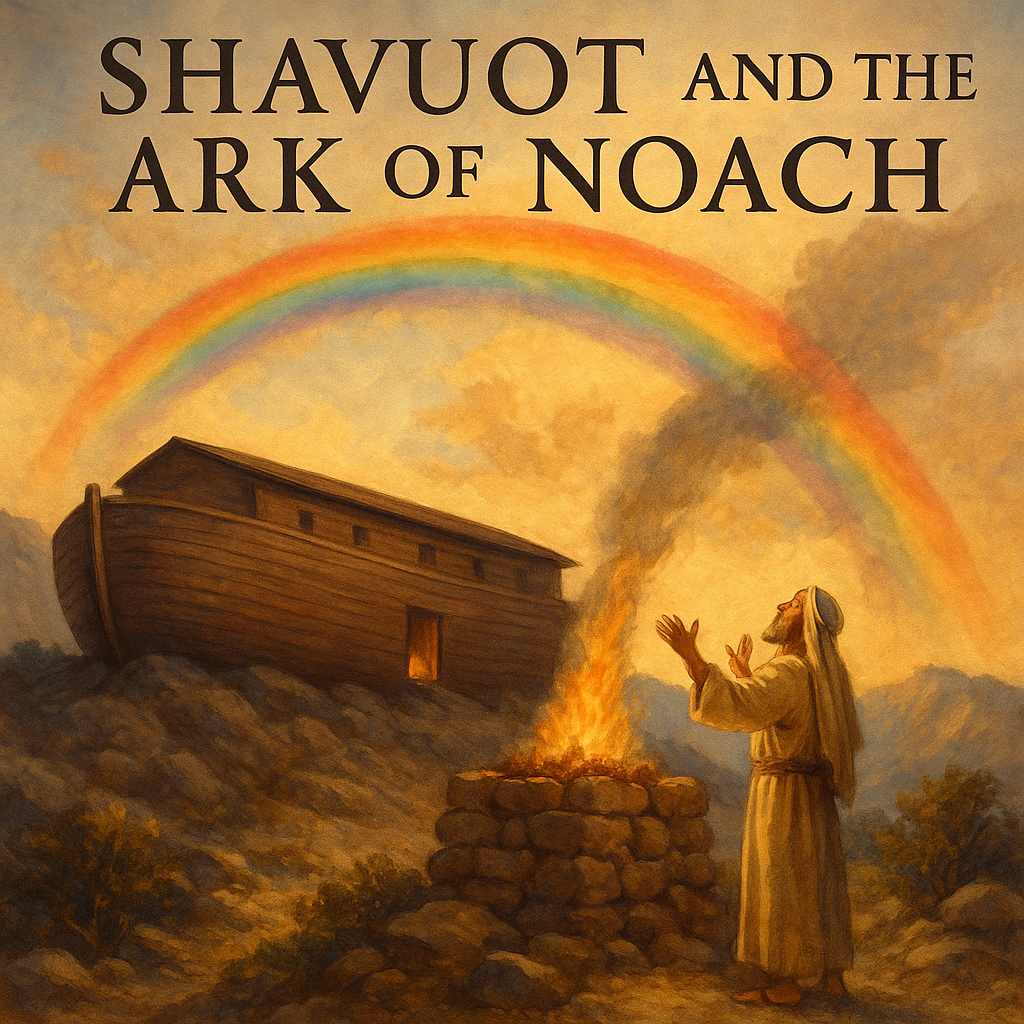
Shavuot and the Ark of Noah: A Prophetic Blueprint for the Last Days
A divine pattern hidden in the flood reveals the end-time restoration of the remnant.
📖 Scripture Reading List
| Torah: • Bereshith (Genesis) 6–9 • Shemoth (Exodus) 19–20 • Wayyiqra (Leviticus) 23:15–22Prophets: • Yirmeyahu (Jeremiah) 31:31–34 • Yoel (Joel) 2:28–32
|
Writings: • Tehillim (Psalms) 119:105Apostolic Writings: • Ma’asei (Acts) 2 • Ivrim (Hebrews) 11:7
|
🔥 Introduction
Shavuot is not just an ancient feast or a spring festival — it is a divine appointment with prophetic weight. As the world descends into rebellion and lawlessness, Yahuah is once again calling His remnant to enter the ark. But this ark is not built with gopher wood — it is built with covenant obedience, truth, and the fire of His Ruach.
For generations, the true meaning of Shavuot has been obscured by tradition, twisted theology, and Rome’s counterfeit religious system. It is not “Pentecost” in the Christian sense. It is the divine renewal of covenant. It is the celebration of the Word, the outpouring of the Ruach, and the sealing of a righteous people.
We must not approach this moed (appointed time) lightly. Shavuot is not about emotional gatherings — it is about holy instruction. It’s not about signs and wonders — it is about obedience and restoration. This is the time when Yahuah speaks from the mountain. This is the moment when He empowers His people to stand, speak, and separate.
The blueprint is hidden in Noach. The pattern is preserved in Torah. And the calling is loud and clear: prepare now, while there is still time.
📚 Section 1: What is Shavuot?
📖 Wayyiqra (Leviticus) 23:15–16
“And from the morrow after the Sabbath, from the day that you brought the sheaf of the wave offering, you shall count for yourselves: seven completed Sabbaths. Until the morrow after the seventh Sabbath you count fifty days, then you shall bring a new grain offering to Yahuah.”
Shavuot (שָׁבוּעוֹת) means “weeks,” commemorating the count of seven complete Sabbaths from the day after the Shabbat following Passover. It marks the culmination of the redemption process that began at Pesach. It is not just a festival of wheat — it is a feast of fire, a day of covenant encounter, and a prophetic shadow of the outpouring of the Ruach upon the obedient remnant.
This appointed time is a picture of marriage. At Sinai, Yahuah proposed with His commandments as the ketubah (marriage contract), and Yisra’el replied, “All that Yahuah has spoken we will do.” This was not merely a national agreement — it was a covenant bond, sealed with blood and fire.
📖 Shemoth (Exodus) 19:1–6
“In the third month after the children of Yisra’el had come out of the land of Mitsrayim… Yahuah called to him from the mountain, saying… ‘If you diligently obey My voice and guard My covenant, then you shall be My treasured possession… and a set-apart nation.’”
This is the foundation of Shavuot: the people are not just delivered from slavery — they are invited to become a kingdom of priests.
📖 Ma’asei (Acts) 2:1–4
“When the Day of Shavuot had fully come… suddenly there came a sound from heaven as of a rushing mighty wind… and they were all filled with the Set-apart Spirit.”
Just as Yahuah descended with fire and thunder at Sinai, so the Ruach descended upon the remnant in Yerushalayim — not to replace Torah, but to write it on their hearts. This was not the birth of a religion; it was the sealing of the renewed covenant.
Hebrew Word Study:
שָׁבוּעַ (Shavua, Strong’s H7620) – week, a period of seven
Root: שָׁבַע (Shava) – to swear, to make a covenant oath
Paleo-Hebrew Picture:
𐤔 Shin = consume, 𐤁 Bet = house, 𐤏 Ayin = eye → “The consuming oath watches over the house”
✅ Are we willing to stand at the mountain again — to hear His voice, embrace His covenant, and be sealed for the days ahead?
📚 Section 2: The Days of Noach and the Feasts
📖 Bereshith (Genesis) 7:11
“In the six hundredth year of Noach’s life… all the fountains of the great deep were broken up, and the windows of the heavens were opened.”
This was not just a natural catastrophe. It was divine judgment on a lawless, corrupt, and violent world. But in the midst of chaos, one man walked with Elohim — and through obedience, prepared an ark of preservation. That ark was not an escape pod; it was a place of covenant protection.
📖 Bereshith (Genesis) 8:14–16
“And in the second month, on the twenty-seventh day of the month, the earth was dry. And Elohim spoke to Noach, saying, ‘Go out of the ark…’”
The journey ends where obedience began — in waiting for Yahuah’s instruction. Noach didn’t move on instinct. He waited for the voice of Elohim, and only then exited the ark to begin restoration.
📖 Jubilees 6:17–18
“He placed the blood upon the altar and celebrated the feast in its season… on the sixteenth day of the third month.”
This detail — while from a non-canonical source — aligns perfectly with the appointed time of Shavuot. Noach emerges, offers sacrifice, and renews covenant with Yahuah. The prophetic picture is stunning: just as Noach stepped out into a cleansed earth and offered an altar, so Yisra’el would stand at Sinai, and the early believers would be filled with the Ruach.
⚠️ Note: The Book of Jubilees is not Scripture, but when tested against Torah and verified through patterns, it can offer historical insights that illuminate timing and alignment.
✅ Do we see that the post-flood altar, the giving of the Torah, and the outpouring of the Ruach all align with one prophetic moed? This is not coincidence — it is the blueprint of restoration.
📚 Section 3: Prophetic Themes Linking Shavuot to Noach
📖 Ivrim (Hebrews) 11:7
“By belief, Noach, having been warned of what was yet unseen, moved with reverence, prepared an ark to save his house, through which he condemned the world and became heir of the righteousness which is according to belief.”
This single verse captures the essence of prophetic obedience. Noach believed before he saw. He acted in obedience before judgment came. He built — not out of fear — but out of reverent trust in Yahuah’s word. This is the same spirit that must be in the remnant today as we prepare our lives for the prophetic fire of Shavuot.
- 🔐 Preservation of the Remnant
Noach was not raptured. He was preserved. The ark did not lift him out of the world — it carried him through judgment. So too, Shavuot is about equipping a remnant to stand through the storm with power, discernment, and sealed identity. The Ruach is not for show — it is for sanctification and strength in tribulation.
- 🕯️ Covenant and Instruction
📖 Bereshith (Genesis) 9:1–4
“Be fruitful and increase, and fill the earth… But do not eat flesh with its life, its blood.”
This post-flood command echoes Eden — dominion, fruitfulness, and blood reverence. Every covenant comes with renewed instruction. Shavuot, from Sinai to Acts, always includes divine directives. It is never just celebration — it is revelation.
📖 Yirmeyahu (Jeremiah) 31:33
“I shall put My Torah in their inward parts, and write it on their hearts…”
This is Shavuot’s ultimate goal — not tablets of stone, but hearts of obedience.
- 🌈 Sign of Covenant
📖 Bereshith (Genesis) 9:13
“I shall set My rainbow in the cloud… it shall be for the sign of the covenant…”
The rainbow is not a symbol of pride or permissiveness. It is a witness that Elohim keeps His promises. In Exodus, the Torah becomes the sign. In Acts, the Ruach becomes the seal. In Revelation, the remnant is marked by both — obedience to the commandments and belief in Yahusha.
✅ Have we misunderstood the Ruach as emotion instead of empowerment? Have we embraced covenant as concept, or are we walking in it as lifestyle?
📚 Section 4: As It Was in the Days of Noach…
📖 Mattithyahu (Matthew) 24:37–39
“And as the days of Noach were, so also shall the coming of the Son of Adam be… until the day that Noach entered into the ark, and they did not know until the flood came and took them all away…”
Yahusha didn’t compare the end times to the days of Mosheh or Dawid. He pointed us to Noach. Why? Because the conditions of lawlessness, corruption, violence, and mockery would return. And so would the remnant response: preparation in righteousness.
📖 2 Kepha (Peter) 2:5
“…and did not spare the world of old, but preserved Noach, a proclaimer of righteousness…”
Noach didn’t just build — he preached. His ark was a witness. His obedience was a sermon. So it must be with us.
The ark today is not wood — it is the life built on Torah, filled with the Ruach, and sealed by faith in Yahusha. The call is not to flee, but to stand. Not to assimilate, but to proclaim.
✅ The question is not “Is the end near?” — the question is: Are we building in faith while the world mocks our obedience?
📚 Section 5: Acts 2 and Shavuot — The Restoration Begins
📖 Ma’asei (Acts) 2:38–39
“Repent, and let each one of you be immersed in the Name of Yahusha Messiah… and you shall receive the gift of the Set-apart Spirit… for as many as Yahuah our Elohim shall call.”
The immersion here was not a ritual — it was a prophetic transfer of identity. Those who obeyed were not just cleansed — they were sealed. The Ruach was not poured out at random; it came on Shavuot. This timing was no accident. The same fire that descended on Sinai now ignited hearts.
📖 Yehezqel (Ezekiel) 36:26–27
“I shall give you a new heart… and put My Spirit within you… and cause you to walk in My laws and guard My right-rulings and do them.”
This is the true purpose of the Spirit: not to replace Torah, but to empower Torah. The Ruach causes obedience. It ignites righteousness. It convicts, teaches, and aligns us with Yahuah’s ways.
Too many treat Acts 2 as the start of a new religion. In truth, it was the continuation of a covenant. The same Elohim. The same Torah. Now written on living tablets — hearts of flesh.
✅ The restoration began in Acts. But it must continue in us. Have we received the Ruach to obey — or just to feel?
🛡️ Prophetic Insight
The days of Noach were filled with lawlessness, corruption, and mockery of righteousness. So it is again. The modern religious system has traded the covenant for counterfeit grace, and exchanged Torah for traditions rooted in Rome. The remnant must not be seduced by emotional experiences masquerading as spiritual truth.
📖 Yeshayahu (Isaiah) 24:5–6
“For the earth has been defiled under its inhabitants, because they have transgressed the Torot, changed the law, broken the everlasting covenant. Therefore a curse has consumed the earth, and those who dwell in it are guilty.”
📖 2 Thessalonians 2:10–11
“And with all deceit of unrighteousness in those perishing, because they did not receive the love of the truth, in order for them to be saved. And for this reason Elohim sends them a working of delusion, for them to believe the falsehood.”
📜 Torah + Prophets Connection
Shavuot is not an isolated ritual. It is a prophetic thread woven through the Torah, affirmed by the Prophets, and fulfilled through Yahusha. The Torah does not just describe the appointed time — it establishes its covenantal purpose. The Prophets do not merely reference the feast — they declare its future fulfillment in the hearts of a restored people.
📖 Shemoth (Exodus) 20:1–2
“And Elohim spoke all these Words, saying, ‘I am Yahuah your Elohim, who brought you out of the land of Mitsrayim, out of the house of slavery.'”
The giving of the Ten Words at Sinai was not merely a moral code — it was the foundation of a nation’s identity. Yahuah didn’t just redeem His people — He instructed them. The covenant began with deliverance and was sealed by obedience. Shavuot marks this moment in divine history — a marriage between Creator and people.
📖 Yirmeyahu (Jeremiah) 31:33
“For this is the covenant I shall make with the house of Yisra’el after those days, declares Yahuah: I shall put My Torah in their inward parts, and write it on their hearts. And I shall be their Elohim, and they shall be My people.”
The Prophet Jeremiah saw beyond Sinai to a time when the covenant would no longer be external — written on stone or spoken from fire — but internal, inscribed on hearts. This is the deeper fulfillment of Shavuot. Not just commands shouted from a mountain, but righteousness flowing from within.
📖 Mattithyahu (Matthew) 5:17
“Do not think that I came to destroy the Torah or the Prophets. I did not come to destroy but to complete.”
Yahusha did not cancel the Torah at Shavuot. He confirmed it. He became the living Torah. He did not start a new covenant out of Rome — He renewed the original covenant in power. Shavuot is when that Torah was re-written on the hearts of the faithful through the Ruach ha’Qodesh.
The Torah teaches the appointed time. The Prophets call the people back to covenant. Yahusha fulfills both — and through Him, Shavuot becomes the day when the remnant is sealed, sanctified, and sent.
✅ Are we living as those who were called out at Sinai, filled at Shavuot, and sent with fire — or have we traded covenant for tradition?
📣 Prophetic Application
We are not awaiting another flood of water — we are already in the flood of deception. The question is: have we built our ark?
Noach obeyed when there was no evidence of rain. He prepared while the world partied. The remnant today must do the same. Do not delay obedience. Do not blend with Babylon. Shavuot is not a tradition — it is a prophetic appointment to be sealed.
This is the hour to:
- Reject lawless religion
- Return to the commands of Yahuah
- Be immersed in the Name of Yahusha
- Walk in the power of the Ruach AND the path of the Torah
- Be marked as a remnant builder in a collapsing world
➤ Application for Us Today
- Stop treating Shavuot like a Christian Pentecost — honor the moed of Yahuah.
• Count the days from First Fruits with diligence — keep the Scriptural timeline.
• Build your ark through covenant obedience, not emotional gatherings.
• Separate from traditions of men — walk in set-apart truth.
• Let the Ruach empower your walk, not replace your need for Torah.
• Prepare your household — obedience is your covering.
• Declare the covenant boldly — even when mocked.
• Be sealed now — before the floodgates open again.
🔔 Final Prophetic Charge
The days of decision are here. The floodwaters are not rising — they are already here. But this time, they are not of water — they are spiritual, cultural, and doctrinal. Yahuah is calling His people out of Babylon, out of confusion, and into covenant.
We must stop playing with religion and start walking in righteousness. The call of Shavuot is not celebration — it is consecration. It is time to be sealed. It is time to be empowered. It is time to come out of hiding and build the ark of truth.
Repent. Return. Rebuild. This is not optional — it is survival. The ark is open. The covenant is calling. Yahuah is watching.
🗣️ Reflection / Review Questions
- What is the significance of counting seven complete Sabbaths before Shavuot?
- How does the event at Mount Sinai connect to the outpouring in Acts 2?
- What role does covenant play in the story of Noach and in Shavuot?
- How does the Book of Jubilees contribute to understanding the prophetic timing of Shavuot?
- Why is it important to view Shavuot as a covenant renewal and not just a historical feast?
- What are the parallels between the days of Noach and today’s generation?
- How is Yahusha both our Ark and our covenant?
- Why must the Ruach and Torah be seen as united and not in conflict?
- What are some real-world signs that a person is building their “ark” today?
- How does the restoration of covenant at Shavuot prepare the remnant for the last days?
📜 Answers to Reflection Questions
- Counting seven complete Sabbaths emphasizes the importance of Yahuah’s timing and prepares the heart to receive.
- The events of Mount Sinai and Acts 2 mirror each other as both involve divine communication, fire, and empowerment.
- Covenant is the heart of both stories. Noach entered covenant through obedience and was preserved.
- Jubilees highlights the alignment of Noach’s offering with Shavuot — a prophetic connection for covenant renewal.
- Shavuot is a time for sealing, instruction, and alignment with Yahuah’s plan.
- Today mirrors Noach’s day with corruption, spiritual apathy, and hostility to righteousness.
- Yahusha is the Ark — the door of preservation, life, and covenant.
- The Ruach enables Torah observance; separating them causes imbalance and deception.
- A remnant builder obeys Torah, leads righteously, and prepares for judgment.
- Shavuot marks and empowers the sealed remnant for last-day service and survival.
📘 Glossary of Key Terms
| Term | Definition | Language | Paleo-Hebrew Picture |
| Shavuot | Feast of Weeks; a moed marking covenant and outpouring | שָׁבוּעוֹת (Shavuot) | 𐤔 Shin = consume, 𐤁 Bet = house, 𐤏 Ayin = eye → “Consuming oath over the house” |
| Torah | Divine instruction, law, guidance | תּוֹרָה (Torah) | 𐤕 Tav = mark, 𐤅 Waw = nail, 𐤓 Resh = head, 𐤄 Heh = behold → “Behold the leader marked by the nail” |
| Noach | Rest, comfort; righteous man preserved in the flood | נֹחַ (Noach) | 𐤍 Nun = life, 𐤇 Chet = fence → “Life protected within a fence” |
| Covenant | Binding agreement between Yahuah and His people | בְּרִית (Berit) | 𐤁 Bet = house, 𐤓 Resh = head, 𐤉 Yod = hand, 𐤕 Tav = mark → “The marked hand over the house’s head” |
| Ruach | Spirit, breath, wind; divine empowerment | רוּחַ (Ruach) | 𐤓 Resh = head, 𐤅 Waw = nail, 𐤇 Chet = fence → “The nailed leader within the protective fence” |
| Moed | Appointed time or feast | מוֹעֵד (Mo’ed) | 𐤌 Mem = chaos, 𐤏 Ayin = eye, 𐤃 Dalet = door → “The eye sees the door through the chaos” |
| Firstfruits | The beginning of the harvest; symbolic of resurrection and dedication | רֵאשִׁית (Reshit) | 𐤓 Resh = head, 𐤀 Aleph = strength, 𐤔 Shin = consume, 𐤕 Tav = mark → “The strong head consumed by the mark” |
| Remnant | The faithful, preserved people of Yahuah | שְׁאֵרִית (She’erit) | 𐤔 Shin = consume, 𐤀 Aleph = strength, 𐤓 Resh = head, 𐤕 Tav = mark → “The strong marked leader preserved” |
| Babylon | System of confusion, rebellion, and mixture | בָּבֶל (Bavel) | 𐤁 Bet = house, 𐤁 Bet = house, 𐤋 Lamed = authority → “Conflicting houses under false authority” |
| Seal | Mark of protection and ownership by Yahuah | חוֹתָם (Hotam) | 𐤇 Chet = fence, 𐤕 Tav = mark, 𐤌 Mem = chaos → “Marked protection amidst chaos” |
✍️ Greg Witter
Ephraim’s Cry | Hebraic Mindset Study Series
Proclaiming the Restoration of Truth — Study ◇ Learn ◇ Apply ◇ Grow ◇ Share ☆ Repeat
Restoring the Covenant of Shavuot — One Sealed Remnant at a Time
