
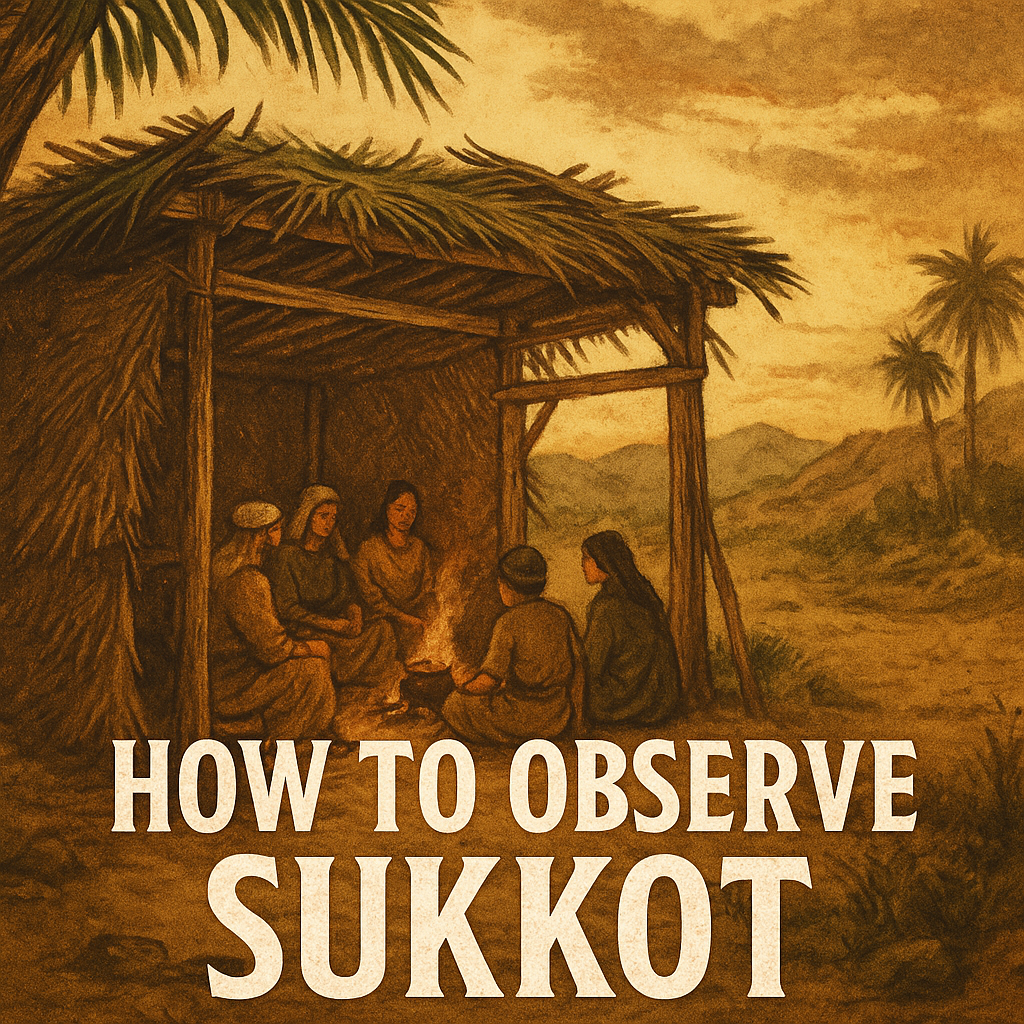
How to Observe Sukkot: the feast of Booths/Tabernacles
From Dwelling in Booths to Dwelling in Glory — A Prophetic Call to Keep Sukkot in Spirit and in Truth
📖 Scripture Reading List
| Torah: • Wayyiqra (Leviticus) 23:33–44 • Bemidbar (Numbers) 29:12–38 • Devariym (Deuteronomy) 16:13–17Prophets: • Zekaryah (Zechariah) 14:16–19 • Neḥemyah (Nehemiah) 8:13–18
|
Writings: • Tehillim (Psalms) 27:5; 91:1 • Ezrah (Ezra) 3:1–6Apostolic Writings: • Yohanan (John) 7:1–2, 10, 37–39 • Ḥazon (Revelation) 7:9–15
|
🔥 Introduction
Sukkot is not a “Jewish tradition” or a holiday of the past — it is a commanded feast of Yahuah (Wayyiqra 23:33–44), full of prophetic power, covenant identity, and kingdom restoration. It is one of the Mo’edim — the appointed times — that Yahuah Himself declared as set-apart rehearsals. In a world increasingly hostile to obedience, the Feast of Sukkot stands as a prophetic declaration: Yahuah still dwells with His people — and we must be ready to dwell with Him.
But before we can rightly walk in obedience, we must speak truthfully: we cannot fully “keep” the feast of Sukkot according to the Torah’s exact instructions — because there is no standing Temple, no Levitical priesthood in place, and no gathering of all twelve tribes in the land of Yisra’el as required by Yahuah’s covenant order (Devariym 16:16; Bemidbar 29). The feasts were given to the nation — not to individuals scattered in exile. To “keep” a feast in Torah terms means to guard and perform all of Yahuah’s requirements in His land, by His calendar, with His people. That is not currently possible in exile.
Yet this does not mean we discard the feast or ignore it like the world or the church system.
No — we OBSERVE it.
To “observe” means to watch for, rehearse, remember, honor, and do what we can in the place of our exile while yearning for the full restoration.
We do not “reinvent” the feast — we remember it.
We do not “adapt” it to modern convenience — we align with the Word.
We do not claim to fulfill what Yahuah has not yet restored — we walk humbly in obedience while awaiting the King.
We observe it as a prophetic rehearsal, an act of covenant loyalty, and a spiritual declaration that says:
“We have not forgotten the ancient path.”
We are not waiting for “heaven.” We are preparing for the Messianic Reign. The final harvest feast — Sukkot — prophetically reveals the coming kingdom of Yahusha HaMashiach and the eternal tabernacling of Yahuah with His covenant-keeping remnant. To observe Sukkot rightly is not just to pitch a tent — it is to prepare a heart, a household, and a nation for the return of the King.
This is not a symbolic ritual — this is a divine appointment.
This is not Judaism — this is obedience to Yahuah’s Torah.
This is not optional — this is the remnant lifestyle.
This is not outdated — this is the prophetic future breaking into the present.
And this is not keeping the feast in full — it is observing in faith, until restoration.
Let the nations ignore His feasts. Let the churches substitute them.
But the remnant must return.
Sukkot is a call to come out of Babylon and dwell under the covering of Yahuah.
It is the rehearsal for the Millennial Kingdom.
It is the banner of the set-apart ones who refuse to compromise.
📚 Section 1: What Is Sukkot?
📖 Wayyiqra (Leviticus) 23:34
“Speak to the children of Yisra’el, saying, ‘On the fifteenth day of this seventh month is the Festival of Sukkot for seven days to Yahuah.’”
Sukkot (סֻכּוֹת), often translated as “Tabernacles” or “Booths,” is the final of the seven appointed feasts (Mo’edim) given by Yahuah — and it prophetically represents the ingathering of the final harvest, the dwelling presence of Yahuah, and the coming reign of Messiah Yahusha. The word “Sukkot” is plural for sukkah (סֻכָּה), which means a temporary shelter, hut, or booth made of natural branches, representing both fragility and protection.
- Hebrew Word Study:
• Sukkah (סֻכָּה) — Strong’s H5521
• Definition: a booth, a shelter, a tabernacle made of woven branches
• Root word: סָכַךְ (sakak) — “to cover, to hedge, to entwine” - Paleo-Hebrew Picture:
• 𐤔𐤒𐤄 (Samekh–Qof–Hay)
• Prophetic meaning: “To support or surround (Samekh), the final gathering (Qof), revealing the breath or presence of Yahuah (Hay).”
• The pictograph points to a shelter of divine presence during a time of separation — a prophetic picture of the last days.
During this feast, Yahuah commanded the children of Yisra’el to live in booths for seven days as a reminder of their time in the wilderness, when He sheltered them, guided them, and manifested His presence among them (Wayyiqra 23:42–43). It was a time of joy, celebration, thanksgiving, and prophetic rehearsal — a shadow of the greater indwelling to come.
The feast is called the “Festival of Ingathering” (Shemot 23:16) because it coincided with the end of the agricultural year — a time of final harvest, when all crops were brought in. Prophetically, this points to the end-time harvest of souls, the gathering of scattered Israel, and the return of Yahusha to tabernacle among His people (Yohanan 1:14, Ḥazon 21:3).
Today, we observe Sukkot not only by building temporary shelters, but by declaring:
“We are still waiting for the Kingdom. We are still exiles in a strange land. And we are still covered by the hand of Yahuah.”
It is a feast that reminds us:
- Our physical dwellings are temporary
- Yahuah’s covering is eternal
- The wilderness was not the end — it was preparation
- The promise is not just deliverance — it is indwelling
Reflective Question:
Are we building our lives on permanent comfort in Egypt — or temporary obedience in the wilderness as we wait for the Kingdom?
📚 Section 2: Why We Observe (Not Keep) Sukkot in Exile
📖 Devariym (Deuteronomy) 16:16
“Three times a year all your males are to appear before Yahuah your Elohim in the place which He chooses: at the Festival of Matzot, and at the Festival of Shavuot, and at the Festival of Sukkot. And none should appear before Yahuah empty-handed.”
To “keep” a feast in the language of Torah is not simply to remember it — it is to guard it, preserve it, and perform every requirement tied to it. This includes offerings at the Temple, attendance in the land of Yisra’el, and service by the Levitical priesthood at Yahuah’s appointed place. Without these divine elements in place, we are not scripturally able to “keep” Sukkot in the full covenant sense.
- Hebrew Word Study:
• Shamar (שָׁמַר) — Strong’s H8104
• Meaning: to keep, guard, preserve, observe with care and diligence
• Root meaning includes “to hedge about as with thorns,” implying careful protection and covenant fidelity. - Paleo-Hebrew Picture:
• 𐤔𐤌𐤓 (Shin–Mem–Resh)
• Prophetic meaning: “The teeth (Shin) consume or guard, the chaos (Mem) of man (Resh)” — a picture of protective obedience that guards against the disorder of disobedience.
Because we are scattered outside the land, under foreign rule, without a functioning priesthood or altar, we cannot fulfill the original requirements of the feast. To claim otherwise is to add or subtract from Torah — something Yahuah strictly forbids (Devariym 4:2).
This is why we say with honesty and humility:
We observe the feast. We do not claim to keep it in fullness.
To observe in Hebraic thought means to “watch for,” “await,” “pay attention to,” and “do what is possible in remembrance and honor.” The pattern of the righteous in exile — from Daniel to Neḥemyah — is not to abandon Yahuah’s commands, but to do what is possible while praying and preparing for restoration.
- Daniel observed the calendar and prayed toward Yerushalayim
- Neḥemyah restored the Word and rebuilt the walls
- Ezra re-established reading of Torah during Sukkot (Neḥemyah 8:13–18)
This is the model of the faithful remnant:
- We do not dismiss the feast because it’s “impractical”
- We do not pretend we are in the land when we are not
- We do not twist Torah to fit our situation
- We observe in faith, in truth, in longing, and in obedience
Yahuah sees the heart that is aligned, not the hands that are limited.
And He honors the set-apart ones who observe His commands in exile, preparing for the full return.
Reflective Question:
Are you pretending you’re already in the Kingdom — or observing in humility while longing for its restoration?
📚 Section 3: How to Observe Sukkot Today — Practical Steps for the Remnant
📖 Wayyiqra (Leviticus) 23:42–43
“Dwell in booths for seven days; all who are native Yisra’elites are to dwell in booths, so that your generations know that I made the children of Yisra’el dwell in booths when I brought them out of the land of Mitsrayim. I am Yahuah your Elohim.”
In the absence of a functioning Temple, altar, or Levitical order, the remnant outside the land of Yisra’el is called to observe Sukkot with sincerity, understanding, and covenant alignment — not with vain tradition or rabbinic confusion. Observing the feast today is not about recreating a perfect ritual — it is about rehearsing the prophetic truth of Yahuah’s covering, His deliverance, and His coming Kingdom.
- Hebrew Word Study:
• Zakar (זָכַר) — Strong’s H2142
• Meaning: to remember, to recall, to mark
• This word implies active remembering with intent to act or prepare. - Paleo-Hebrew Picture:
• 𐤆𐤒𐤓 (Zayin–Qof–Resh)
• Prophetic meaning: “A weapon (Zayin) marking the final (Qof) man (Resh)” — picturing a remnant that remembers the weapon of Yahuah’s deliverance and prepares for the end-time gathering.
How then should we observe Sukkot today?
- Set Apart the Appointed Time
– The 15th through the 21st day of the 7th biblical month (not the rabbinic calendar).
– Count by the Torah-based 364-day solar calendar, anchored in Aviv.
– Prepare your home and heart in advance. - Dwell in Temporary Shelters
– Build a sukkah (booth) made of natural materials like branches or palm leaves.
– Dwell in it daily — eat, read, rest, and reflect in the booth to remember the wilderness journey.
– If dwelling is not possible, spend daily time in or around it, honoring its purpose. - Read and Proclaim the Word
– Read Wayyiqra 23, Devariym 16, and Neḥemyah 8 aloud during the week.
– Teach your children and household the meaning of the feast.
– Remember that the booths were built after the people rediscovered Torah. - Rejoice Before Yahuah
– Sukkot is the only feast that commands joy (Devariym 16:14–15).
– Sing, dance, and rejoice in His covering, His deliverance, and His promises.
– Make this a set-apart time of celebration, not just information. - Gather if Possible
– While we are in exile, physical gatherings matter — even in small numbers.
– Host, visit, or attend a set-apart gathering of like-minded believers.
– Practice righteousness, unity, and order without compromise. - Give an Offering of Thanksgiving
– While we cannot bring Temple sacrifices, we can bring offerings of gratitude.
– Give to the poor, support the remnant, and bless those teaching truth.
– Remember: “None shall appear before Me empty-handed” (Devariym 16:16). - Prepare for the Greater Dwelling
– Use this week to reflect on Yahusha’s first and second coming.
– Meditate on Ḥazon 21:3 — “Behold, the Tabernacle of Elohim is with men.”
– Examine your life — is it ready to become a dwelling place for Yahuah?
Reflective Question:
Is your sukkah made of branches only — or is your heart also built to host the presence of the Most High?
📚 Section 4: The Prophetic Meaning of Sukkot in the Last Days
📖 Zekaryah (Zechariah) 14:16
“And it shall be that all who are left from all the nations which came up against Yerushalayim shall go up from year to year to bow themselves to the Sovereign, Yahuah of hosts, and to celebrate the Festival of Sukkot.”
Sukkot is not just a remembrance of the wilderness — it is a rehearsal for the Kingdom. This final feast in the cycle of Yahuah’s Mo’edim is a prophetic marker of the Millennial Reign of Yahusha, when He will tabernacle with His people, restore all things, and rule from Yerushalayim with righteousness.
- Hebrew Word Study:
• Chag (חַג) — Strong’s H2282
• Definition: a feast, festival, a pilgrimage gathering
• From the root chagag, meaning “to move in a circle, to keep a pilgrimage feast” - Paleo-Hebrew Picture:
• 𐤇𐤂 (Chet–Gimel)
• Prophetic meaning: “A fence (Chet) for the one who walks (Gimel)” — a picture of Yahuah’s appointed times providing protection and direction for His covenant people as they journey through exile and into His Kingdom.
Sukkot represents the final ingathering — both agriculturally and spiritually. It is the time when Yahuah gathers His people from the four corners of the earth (Yeshayahu 11:12), brings them back to the land, and establishes His dwelling among them permanently (Yeḥezqel 37:26–28).
During the Millennial Kingdom, the nations will be required to come up to Yerushalayim to observe Sukkot — or suffer drought and plague (Zekaryah 14:17–19). This proves beyond debate: Sukkot is not done away with. It is not “Old Testament.” It is the appointed Kingdom feast of Yahusha when He reigns as King.
Yohanan (John) tells us that Yahusha Himself came during Sukkot (John 7:2, 10, 37) and prophetically declared:
“If anyone thirsts, let him come to Me and drink… Out of his innermost being will flow rivers of living water.”
— Yohanan (John) 7:37–38
This was spoken on the last great day of Sukkot, when the water-drawing ceremony would have been performed. Yahusha was declaring that He is the fulfillment of the Water from the Rock, the Living Tabernacle, and the indwelling presence of Yahuah.
- Sukkot reminds us that we are still sojourners in a world that is not our home.
- Sukkot points us forward to the New Yerushalayim, when the Tabernacle of Elohim will be with men (Ḥazon 21:3).
- Sukkot declares that Yahusha is coming again — not as a lamb, but as reigning King.
Reflective Question:
Are you observing Sukkot as a religious habit — or as a prophetic declaration that you are preparing for the Kingdom of Yahusha?
📚 Section 5: Yahusha and the Fulfillment of Sukkot
📖 Yohanan (John) 1:14
“And the Word became flesh and dwelt among us, and we beheld His esteem, esteem as of an only brought-forth of a father, complete in favor and truth.”
The word translated “dwelt” here is skēnoō (σκηνόω, Strong’s G4637) — literally meaning “to tabernacle, pitch a tent, or dwell in a booth.” This is no coincidence. Yahusha, the Living Word, came and “tabernacled” among us — fulfilling the very essence of Sukkot. His first coming was a foreshadow of what the feast always pointed toward: Yahuah dwelling in the midst of His people in human form.
- Greek Word Study:
• Skēnoō (σκηνόω) — Strong’s G4637
• Meaning: to tent or encamp, to dwell as in a tabernacle
• Rooted in the idea of temporary dwelling — but with eternal intent. - Paleo-Hebrew Picture of “Mishkan” (Tabernacle):
• 𐤌𐤔𐤊𐤍 (Mem–Shin–Kaph–Nun)
• Prophetic meaning: The flowing water (Mem) that consumes (Shin), covers (Kaph), and brings forth life or seed (Nun).
• It is a picture of Yahusha — the Living Water, the covering of fire, and the promised Seed who would restore covenant.
Yahusha not only dwelt among us — He fulfilled the pattern of Sukkot in every way:
- He is the Light that illuminated the world, like the menorahs lit during the festival.
- He is the Living Water poured out on the last great day of the feast.
- He is the Torah in flesh, the very presence of Yahuah veiled in a tent of human form.
- He is the true Tabernacle, in whom the fullness of Elohim dwells bodily (Qolosim 2:9).
- He is the King who will command all nations to observe this feast when He returns in glory (Zekaryah 14:16).
But there’s more.
Yahusha will not only tabernacle among us again — He will establish a Kingdom where righteousness, Torah, and truth dwell. And Sukkot will be the appointed time when all nations must bow to His reign or face judgment (Zekaryah 14:18–19).
Those who refuse the feast today will be forced to recognize it tomorrow.
Those who reject Yahusha as the indwelling presence of Yahuah will one day see Him enthroned in Yerushalayim.
And those who honor Sukkot now — in exile — are declaring in advance:
“We are ready to receive the King. Our hearts are His dwelling place.”
Reflective Question:
If Yahusha tabernacled among us once, and is coming to reign again — is your life prepared to become His sukkah?
📚 Section 6: The Coming Judgment on Those Who Refuse Sukkot
📖 Zekaryah (Zechariah) 14:17
“And it shall be, that whichever of the clans of the earth do not come up to Yerushalayim to bow themselves to the Sovereign, Yahuah of hosts, on them there is to be no rain.”
The Feast of Sukkot is not merely a “nice tradition” for Israel — it is a commanded covenant marker. In the final age — after Yahusha returns and establishes His reign from Mount Tsiyon — the keeping of Sukkot will not be optional. It will be enforced by the King Himself.
- Hebrew Word Study:
• Geshem (גֶּשֶׁם) — Strong’s H1653
• Meaning: rain, downpour, or blessing
• In Hebraic thought, rain is symbolic of Yahuah’s provision, favor, and word (see Yeshayahu 55:10–11). - Paleo-Hebrew Picture:
• 𐤂𐤔𐤌 (Gimel–Shin–Mem)
• Prophetic meaning: “The one who walks (Gimel) through the fire (Shin) receives the water (Mem).”
• A clear image of trial, obedience, and the reward of provision — or the judgment of drought for rebellion.
Zekaryah 14 describes a time after the return of Yahusha, when the remnant of all surviving nations will be required to go up to Yerushalayim every year to observe Sukkot. Those who refuse will experience a prophetic consequence: no rain — which represents both physical drought and spiritual barrenness.
But that is not all.
Verse 18 reveals that if Egypt or any nation fails to come up, Yahuah will strike them with a plague — the very same plague that once judged Pharaoh. This is no symbolic warning. It is a literal declaration from the mouth of Yahuah. To refuse Sukkot in the age to come is to reject the King, the Kingdom, and the covering that this feast represents.
And make no mistake: if that is the standard in the future, then the remnant must walk in that standard now.
Those who ignore Sukkot today:
- Are unknowingly aligning with the nations destined for judgment
- Are refusing the covering of Yahuah
- Are despising the appointed times of the coming King
- Are cutting themselves off from the prophetic flow of living water
To those still clinging to Christian tradition, Sunday worship, or holidays not found in Torah — let this stand as a warning: Yahuah does not bless the works of Babylon. He has already appointed the times. He has already written the calendar. And He has already told us which feasts matter.
There is no excuse. There is only obedience — or rebellion.
Reflective Question:
If refusing Sukkot in the Kingdom will bring drought and plague — why would you neglect to observe it now?
📚 Section 7: The Joy of Dwelling with Yahuah — Sukkot as Celebration and Restoration
📖 Devariym (Deuteronomy) 16:14–15
“And you shall rejoice in your festival, you and your son and your daughter and your male servant and your female servant and the Levite, and the stranger and the fatherless and the widow who are within your gates. For seven days you shall observe the festival to Yahuah your Elohim in the place which Yahuah chooses, because Yahuah your Elohim does bless you in all your increase and in all the work of your hands, and you shall only be rejoicing!”
Sukkot is unique among the Feasts of Yahuah because it is the only one that carries a direct command to rejoice. It is not a suggestion. It is a Torah-mandated outpouring of covenant celebration, overflowing from the assurance of Yahuah’s provision, protection, and presence.
- Hebrew Word Study:
• Sameach (שָׂמֵחַ) — Strong’s H8056
• Meaning: joyful, merry, glad, rejoicing
• It is related to simchah (joy) — a joy rooted in covenant truth, not worldly pleasure. - Paleo-Hebrew Picture:
• 𐤔𐤌𐤇 (Shin–Mem–Chet)
• Prophetic meaning: “To consume (Shin) the chaos (Mem) within the fence (Chet)” — a picture of spiritual joy and peace found within the protective boundaries of Torah.
Sukkot is not only a rehearsal of end-time restoration — it is a season of rejoicing over what has already been restored. It is the time when we remember how far He has brought us, how much He has covered us, and how faithful He has been to fulfill His word even while we were in exile.
The joy of Sukkot is:
- The joy of freedom from Egypt
- The joy of provision in the wilderness
- The joy of Torah restored and proclaimed (Neḥemyah 8)
- The joy of Yahusha revealed as Living Water
- The joy of prophetic expectation — knowing He will dwell among us again
And this joy is not selfish. It must be shared.
The Torah explicitly commands us to include the widow, orphan, stranger, and Levite — reminding us that covenant joy must overflow into covenant generosity. Sukkot is not about isolating ourselves in spiritual pride — it is about welcoming the broken, the hungry, and the lost into the joy of Yahuah’s covering.
This is the heart of the Kingdom.
This is the restoration of Eden.
This is the joy set before us — when Yahuah will wipe away every tear, dwell among us, and declare:
“Behold, I make all things new” (Ḥazon 21:5).
For those who observe Sukkot now — even in imperfection and exile — there is a foretaste of that joy.
For those who reject the feast — joy will be replaced with judgment.
But for the remnant, Sukkot is the banner of restoration, the mark of obedience, and the overflowing joy of those preparing to dwell with Yahuah forever.
Reflective Question:
Does your Sukkot celebration reflect the commanded joy of the covenant — or the burden of tradition without purpose?
🔥 Prophetic Insight
The widespread neglect of Yahuah’s appointed times — especially Sukkot — is not accidental. It is the fruit of a deliberate replacement strategy by the beast system, engineered to erase the calendar of Yahuah and replace it with the calendar of Rome. What began with Constantine and the early church fathers has now become a global religious deception — where man-made holidays are celebrated, and Yahuah’s feasts are ignored.
Sunday “worship.” Christmas. Easter. Halloween harvest festivals in disguise. These are the counterfeits.
They are not light-hearted traditions — they are spiritual rebellion dressed in religious garb.
Sukkot is the final test. It is the feast that separates those who follow the Lamb from those who follow the system.
And yet, the modern church — and even many in the Messianic and Hebrew Roots movements — treat Sukkot as a vacation, a party, or worse, a platform for rabbinic culture instead of Torah obedience. They have turned the covering of Yahuah into a circus of compromise, rather than a consecrated gathering of the righteous.
📖 Yeshayahu (Isaiah) 29:13
“And Yahuah says, ‘Because this people has drawn near with its mouth, and with its lips they have esteemed Me, yet it has kept its heart far from Me, and their fear of Me has become a command of men that is taught!’”
📖 Marqos (Mark) 7:9
“Well do you set aside the command of Elohim, in order to guard your tradition.”
This is the war of Sukkot — not just tents and palm branches — but truth against tradition.
Yahuah is not looking for performance. He is looking for people who will observe in exile with brokenness, reverence, and joy — longing for His return.
Sukkot is not optional. It is not seasonal. It is not rabbinic.
It is a prophetic declaration:
The King is coming. Prepare the tent. Clean the house. Sanctify the heart.
📜 Torah/Prophets Connection
From the wilderness to the prophets to the last book of Scripture, Sukkot has always stood as a marker of covenant faithfulness, a rehearsal for redemption, and a picture of Yahuah’s desire to dwell among His people. It was never a temporary custom. It was a perpetual command — a feast that prophetically proclaims the end from the beginning.
📖 Shemot (Exodus) 23:16
“And the Festival of the Ingathering at the outgoing of the year, when you have gathered in the fruit of your labors from the field.”
This “ingathering” is not just agricultural — it is prophetic. The harvest points to the regathering of the 12 tribes and the final return of the remnant.
📖 Wayyiqra (Leviticus) 23:41–43
“And you shall observe it as a festival to Yahuah for seven days in the year — a law forever in your generations. Dwell in booths, so your generations know that I made Yisra’el dwell in booths when I brought them out of Mitsrayim.”
Sukkot connects the past deliverance from Egypt with the future deliverance from the nations.
📖 Devariym (Deuteronomy) 16:13–17
“You shall observe the Festival of Sukkot seven days… and you shall rejoice. Three times a year, all your males shall appear before Yahuah your Elohim in the place He chooses.”
This is a national command — rooted in the land, the altar, and the priesthood. Though we are in exile, we observe in faith until that order is restored.
📖 Neḥemyah (Nehemiah) 8:14–17
“And they found written in the Torah… that the children of Yisra’el should dwell in booths during the festival… and there was very great gladness.”
After the exile, when Torah was rediscovered, Sukkot was one of the first commands restored. This is the model of a repentant nation: return to the feasts, and the joy returns with them.
📖 Zekaryah (Zechariah) 14:16–19
“All who are left from the nations shall go up year by year… and those who do not come up… on them there is no rain.”
This is post-return, post-war, in the reign of Messiah. Sukkot will be required of all nations. Those who ignore it will face divine judgment.
📖 Ḥazon (Revelation) 7:9–15
“They are before the throne of Elohim, and serve Him day and night in His Dwelling Place. And He who sits on the throne shall spread His tent over them.”
The final picture is Sukkot fulfilled — Yahuah spreads His sukkah over the redeemed, and His tabernacle is with men (Ḥazon 21:3).
Sukkot is not a feast of the past. It is the future.
It is the visible link between the covenant given at Sinai and the Kingdom established in Yerushalayim.
And those who walk in the words of the Torah and Prophets will not be caught off guard when the King tabernacles with His own once again.
📣 Prophetic Application
The Feast of Sukkot is a test. It divides those who walk in covenant obedience from those who cling to religious tradition. It exposes whether we will follow Yahuah’s calendar or the counterfeit rhythms of Babylon. It reveals whether we are preparing for the Kingdom — or pretending it’s already here.
In every generation, Yahuah has a remnant. A people who will build booths in exile. A people who will rejoice in the wilderness. A people who long for Zion and are not satisfied with Egypt’s comforts. This is the prophetic remnant — not seeking emotional experience, but crying out for the presence and rule of Yahuah to return in full.
Too many today treat Sukkot as either irrelevant or as a spiritualized metaphor. Some turn it into a festival of flesh — camping, eating, music, and fun — with no call to repentance, no proclamation of truth, and no longing for the restoration of Israel. This is not the heart of Sukkot. The real observance is a cry from the wilderness: “Dwell with us, Yahuah! Restore Your Kingdom! Bring us home!”
If you’re not building your life to receive the King — you’re not observing Sukkot.
If your sukkah is a tradition without Torah — it’s a booth without covering.
If your celebration ignores the coming judgment — your joy is counterfeit.
The time to play church is over. The time to rehearse the Kingdom has come.
➤ Application for Us Today
- Set apart the 15th–21st day of the 7th month on the biblical solar calendar, not the rabbinic one.
- Build a physical sukkah if possible, and dwell, eat, or reflect in it daily — as a prophetic witness.
- Read the Torah portions on Sukkot (Wayyiqra 23, Devariym 16, Neḥemyah 8) aloud with your household.
- Invite the stranger, the widow, and the poor to join in your celebration — as commanded.
- Fast and pray leading up to the feast, preparing your heart for His presence.
- Teach your children the meaning of each feast day and how it points to Yahusha.
- Refuse all pagan fall festivals and church alternatives — reject compromise.
- Declare boldly and publicly: “I observe the Feasts of Yahuah. I await the King!”
🔔 Final Prophetic Charge
You were not born in this generation by accident. You were not called out of Babylon to return halfway. The Feast of Sukkot is not just a command — it is a call to war, a declaration of alignment, and a prophetic rehearsal of what is coming upon the earth.
You are either preparing to dwell with Yahuah — or you are building your own house in a land marked for judgment.
You are either observing Sukkot in exile — or you are mocking the King’s appointment.
You are either in covenant — or you are in compromise.
There is no neutral ground.
In the days ahead, as the world descends further into chaos, famine, and deception, the only covering that will stand is the covering of Yahuah. The only shelter from the storm will be the sukkah of the Most High. And the only people who will endure are those who have already chosen to align with His ways — not man’s.
Now is the time to raise up the booths.
Now is the time to tear down the idols.
Now is the time to prepare to dwell with the King.
Choose this day whom you will serve — and build your sukkah accordingly.
🗣️ Reflection / Review Questions
- What is the biblical meaning of Sukkot, and how does it differ from modern traditions or rabbinic observance?
- Why is it inaccurate to claim we are “keeping” Sukkot while in exile? What does it mean to truly “observe” it?
- How does the command to dwell in booths point to both historical deliverance and future prophetic fulfillment?
- What are some practical ways to honor the Feast of Sukkot today, even while scattered outside the land?
- How does Sukkot prophetically connect to the Millennial Reign of Yahusha and the restoration of Yisra’el?
- Why will the nations be judged in the future for refusing to come up to Yerushalayim to observe Sukkot?
- What does the command to rejoice during Sukkot reveal about Yahuah’s heart toward His people?
- In what ways did Yahusha fulfill the meaning of Sukkot during His first coming? How will He fulfill it in His return?
- What are the dangers of turning Sukkot into a cultural or fleshly celebration without spiritual conviction?
- Do you truly long for the return of the King — and is your life structured to receive Him?
📜 Answers to Reflection Questions
- Sukkot is the commanded Festival of Booths given by Yahuah (Wayyiqra 23), symbolizing His provision, presence, and prophetic plan to dwell with His people. Modern traditions either ignore it or distort it through rabbinic rituals or church substitutes.
- To “keep” a feast requires Temple service, Levitical priesthood, and national obedience in the land of Yisra’el. In exile, we cannot fulfill these. We “observe” by remembering, rehearsing, and honoring the command to the best of our ability.
- The booths remind us that Yahuah made our ancestors dwell in temporary shelters in the wilderness. They also point to our current exile and our longing for the final gathering when He will tabernacle with us again.
- By building a sukkah, reading the Torah portions, rejoicing, giving thanks, gathering with others, and publicly declaring Yahuah’s appointed times. All of these honor the feast in exile without corrupting it.
- Sukkot represents the final harvest and the prophetic ingathering of the twelve tribes. During the Millennial Reign, all nations will be required to come to Yerushalayim to observe this feast in honor of the reigning King, Yahusha.
- Zekaryah 14 says any nation that refuses to come up will receive no rain and will be struck with plague. This shows Sukkot is a future requirement, not a past tradition, and rejection of it brings judgment.
- Sukkot is the only feast where we are directly commanded to rejoice. It reveals Yahuah’s desire for His people to live in joy under His covering, knowing they are provided for, protected, and destined to dwell with Him forever.
- Yahusha came during Sukkot and declared Himself the Living Water and the Light of the World. He fulfilled the dwelling presence of Yahuah in flesh. When He returns, He will reign during Sukkot and require all nations to observe it.
- Turning Sukkot into entertainment or rabbinic tradition removes the power of its prophetic call. It becomes an empty form with no heart for the Kingdom, no cry for restoration, and no fear of Yahuah.
- If your calendar, your heart, and your home are not aligned with Yahuah’s appointments — you are not preparing for His return. Observing Sukkot is a declaration that you are building your life to receive the King.
📘 Glossary of Key Terms
| Term | Definition | Language | Paleo-Hebrew Picture |
| Sukkot | The seventh and final feast of Yahuah; a seven-day appointed time of rejoicing, dwelling in booths, and celebrating the prophetic ingathering of Yisra’el under Yahuah’s covering. | Hebrew | 𐤔𐤒𐤕 — Support (Samekh), gather (Qof), mark/covenant (Tav) — a prophetic picture of the final gathering marked for covenant protection |
| Sukkah | A temporary dwelling or booth made of natural materials, commanded during Sukkot. Symbol of shelter and dependence. | Hebrew | 𐤔𐤒𐤄 — Support (Samekh), gather (Qof), reveal presence (Hay) |
| Shamar | To keep, guard, watch over with diligence; used in reference to guarding feasts and commandments. | Hebrew | 𐤔𐤌𐤓 — Teeth (Shin) guard, chaos (Mem), man (Resh) |
| Zakar | To remember, to mark, to recall with action; active remembrance tied to obedience. | Hebrew | 𐤆𐤒𐤓 — Weapon (Zayin), final (Qof), man (Resh) |
| Sameach | Joyful, glad, rejoicing — commanded during the feast of Sukkot. | Hebrew | 𐤔𐤌𐤇 — Consume (Shin), chaos (Mem), within the fence (Chet) |
| Geshem | Rain, outpouring, or blessing; symbol of provision and judgment depending on obedience. | Hebrew | 𐤂𐤔𐤌 — Walk (Gimel), fire/consume (Shin), water (Mem) |
| Skēnē | Tent, tabernacle, dwelling; Greek term used in Yohanan 1:14 for Yahusha’s dwelling. | Greek | N/A — Transliteration from Hebrew mishkan |
| Mishkan | The Tabernacle; dwelling place of Yahuah in the wilderness; points to Yahusha. | Hebrew | 𐤌𐤔𐤊𐤍 — Flow (Mem), consume (Shin), cover (Kaph), seed (Nun) |
| Mo’edim | Appointed times or set-apart feast days established by Yahuah in the Torah. | Hebrew | 𐤌𐤀𐤃𐤉𐤌 — Chaos (Mem), strength (Aleph), door (Dalet), hand (Yod), chaos (Mem) — Yahuah’s strength opens access through appointed chaos to restoration |
| Chag | Feast, festival, pilgrimage gathering — used specifically of commanded celebrations. | Hebrew | 𐤇𐤂 — Fence (Chet), walk/gathering (Gimel) — a circle of protection and worship |
| Yashab | To dwell, settle, or remain; foundational for understanding Yahuah’s desire to abide among His people. | Hebrew | 𐤉𐤔𐤁 — Arm/hand (Yod), consume (Shin), house (Bet) — His hand consumes to establish a dwelling |
| Qodesh | Set-apart, holy; describes Yahuah, His people, and His appointed times. | Hebrew | 𐤒𐤃𐤔 — Final/gathering (Qof), door (Dalet), teeth/consume (Shin) — a gate of separation unto Yahuah |
| Tzafon | North or hidden; prophetically tied to exile, mystery, and the hidden remnant. | Hebrew | 𐤑𐤐𐤍 — Righteous path (Tsade), mouth (Peh), seed (Nun) — the hidden righteous remnant who will speak truth and bring forth life |
Greg Witter
Ephraim’s Cry | Hebraic Mindset Study Series
Proclaiming the Restoration of Truth — Study ◇ Learn ◇ Apply ◇ Grow ◇ Share ☆ Repeat
From Dwelling in Booths to Dwelling in Glory — The Final Ingathering Has Begun
#GregWitter #EphraimsCry #SabbathRestoration #TorahTruth #ComeOutOfBabylon #RemnantAwakening #HebraicRoots #AncientPaths #KingdomObedience #MarkOfTheBeastWarning #Sukkot #FeastOfTabernacles #IngatheringOfIsrael #Moedim #YahuahsCalendar #EndTimeRestoration
