
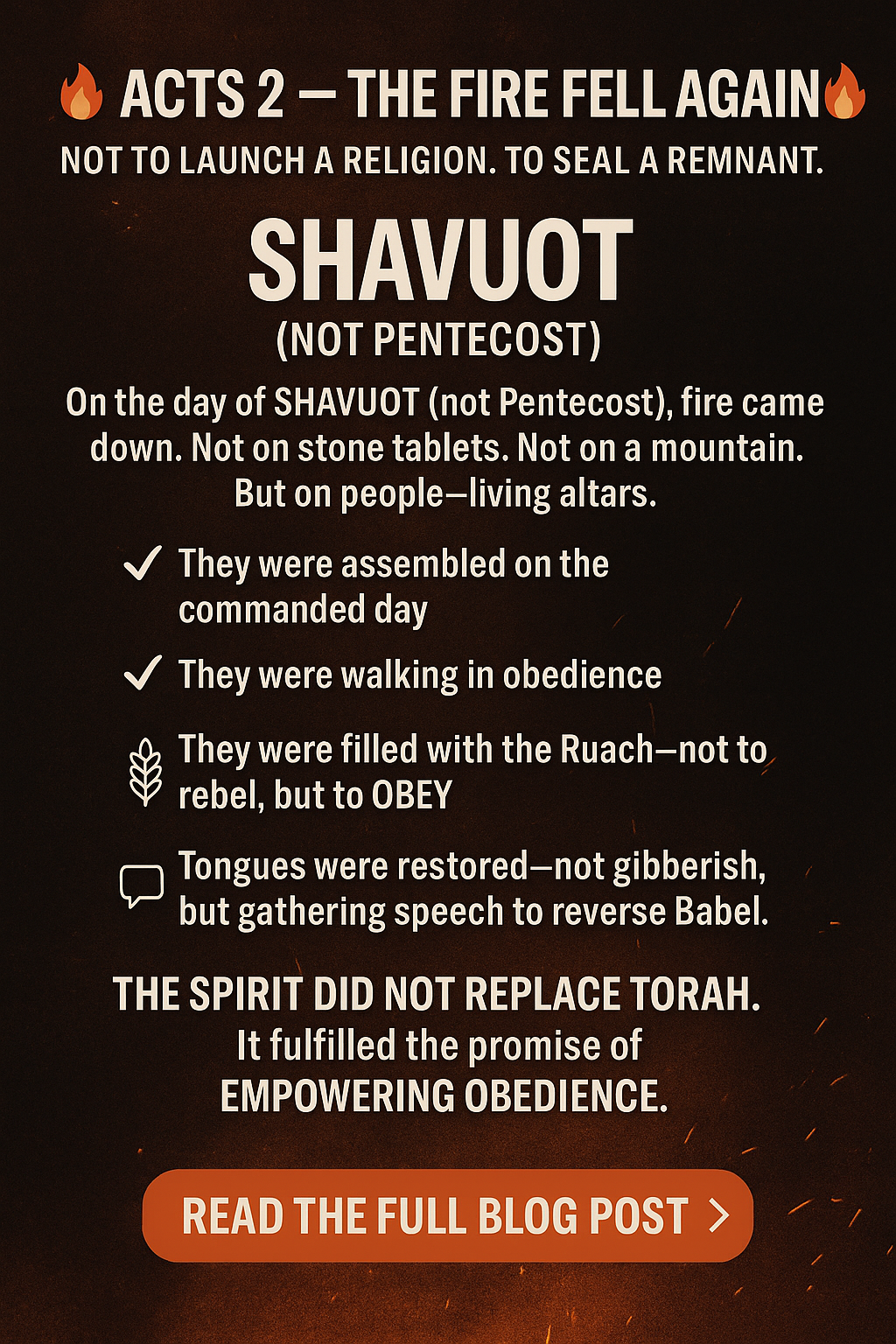
What Happened at Shavuot in the Book of Acts?
The Fire Fell Again — Not to Start a Religion, But to Awaken the Covenant Remnant
✍ By Greg Witter
Ephraim’s Cry | Hebraic Mindset Study Series
Proclaiming the Restoration of Truth — Study ◇ Learn ◇ Apply ◇ Grow ◇ Share ☆ Repeat
🔖 Scripture Reading List
Torah
• Wayyiqra (Leviticus) 23:15–21
• Shemoth (Exodus) 19:16–18
Prophets
• Yeḥezqel (Ezekiel) 36:26–27
• Yo’el (Joel) 2:28–32
Writings
• Tehillim (Psalms) 110:1–2
• Mishlė (Proverbs) 1:23
Apostolic Writings
• Ma’asei (Acts) 2:1–41
• Luke 24:49
🔥 Introduction
Acts 2 is not a random outpouring. It is the fulfillment of a covenant pattern that began at Mount Sinai. The fire, the voice, the wind—it all happened before. What took place on Shavuot in Acts 2 was not the birth of a new religion. It was the renewal of a covenant people.
They were not waiting for an emotional experience. They were waiting in obedience to the Torah—counting the Omer, keeping the Mo’edim, expecting the power of promise Yahusha taught straight from the Prophets.
This moment was the restoration of the fire from Sinai—but now written on hearts.
✏ Section 1: Timing and Context — They Were Obeying Torah
“And when the day of Shavuot had fully come, they were all with one mind in one place.”
— Ma’asei (Acts) 2:1, TS2009
Hebrew & Greek Roots
Shavuot (שָׁבוּעֹת) — Feast of Weeks
Mo’ed (מוֹעֵד) — Appointed time, divine appointment
Paleo-Hebrew Word Picture
• Shin (𐤔) = consume
• Bet (𐤁) = house
• Ayin (𐤏) = see
→ “The house sees the consuming fire.”
Teaching
Shavuot had fully come because they obeyed Torah. They had counted 49 days, and now, on the 50th, they were gathered as commanded. Yahusha told them to wait in Yerushalayim—not randomly, but according to the calendar of Yahuah. Their obedience positioned them for the outpouring.
Prophetic Insights
• Power comes to those walking in Torah timing.
• Shavuot is the appointed moment for fire to fall.
Torah & Prophets Connection
Wayyiqra 23 commands the 50-day count and a set-apart assembly. Luke 24:49 confirms Yahusha instructed them to wait for it.
✏ Section 2: The Sound from Heaven — The Manifest Presence
“And suddenly there came a sound from the heaven, as of a rushing mighty wind…”
— Ma’asei (Acts) 2:2, TS2009
Hebrew & Greek Roots
Ruach (רוּחַ) — Spirit, breath, wind
Phōnē (φωνῐ) — Sound, voice, utterance
Paleo-Hebrew Word Picture
• Resh (𐤓) = head
• Waw (𐤅) = secure
• Chet (𐤇) = fence
→ “The head is secured by the set-apart enclosure.”
Teaching
The sound was not mere wind—it was the audible breath of Elohim, the same Ruach that hovered over creation in Genesis 1. This was the voice of Yahuah filling the house—just as His presence filled the Tabernacle and the Temple. But now, the temple was people.
Prophetic Insights
• This sound was the return of the voice from Sinai.
• The house was filled—because hearts were ready.
Torah & Prophets Connection
Shemoth (Exodus) 19:16–18 records the thunderous arrival of Yahuah at Mount Sinai.
✏ Section 3: Divided Tongues of Fire — The Covenant Seal
“And there appeared to them divided tongues, as of fire, and it settled on each one of them.”
— Ma’asei (Acts) 2:3, TS2009
Hebrew & Greek Roots
Esh (אֵשׁ) — Fire
Lashon (לָשׁוֹן) — Tongue, language, speech
Paleo-Hebrew Word Picture
• Aleph (𐤀) = strength
• Shin (𐤔) = consume
→ “Strong consuming power”
Teaching
Fire on Sinai. Fire in the bush. Fire on the altar. Now fire on the heads of the obedient. This fire was not symbolic. It was covenant fire—marking them as living altars. The divided tongues symbolize one fire divided among many—unity in Spirit, diversity in mission.
Prophetic Insights
• Fire has returned—but now to the temple of flesh.
• Each person bore the flame—each became a witness.
Torah & Prophets Connection
Wayyiqra (Leviticus) 9:24 — fire from Yahuah consumes the offering and marks His approval.
✏ Section 4: Filled with the Ruach — Empowered to Obey
“And they were all filled with the Set-Apart Spirit…”
— Ma’asei (Acts) 2:4, TS2009
Hebrew & Greek Roots
Ruach HaQodesh (רוּח הַקוֹדֶש) — Set-Apart Spirit
Dunamis (δὐναμις) — Power, might, ability
Paleo-Hebrew Word Picture
• Resh (𐤓) = head
• Waw (𐤅) = secure
• Qof (𐤒) = horizon
→ “The head is secured by the vision beyond.”
Teaching
This was not emotionalism or confusion. This was power to obey. The Ruach HaQodesh causes us to walk in His statutes (Ezekiel 36:27). The disciples were already walking in Torah—now they were sealed for the mission. Power without Torah is chaos. Torah without Spirit is incomplete.
Prophetic Insights
• The Ruach empowers what Torah commands.
• This is the Spirit of obedience—not rebellion.
Torah & Prophets Connection
Yeḥezqel 36:27 confirms the Ruach causes us to walk in Yahuah’s commands.
✏ Section 5: Speaking in Tongues — Reversing Babel
“And how do we hear, each one in our own language…? We hear them speaking… the great deeds of Elohim!”
— Ma’asei (Acts) 2:8–11, TS2009
Hebrew & Greek Roots
Lashon (לָשׁוֹן) — Language
Glōssa (γλῶσσα) — Tongue, dialect, speech
Paleo-Hebrew Word Picture
• Lamed (𐤋) = authority
• Shin (𐤔) = consume
→ “The authority that consumes falsehood.”
Teaching
This was not gibberish. This was known languages being spoken and understood. This was the reversal of Babel. Where languages once scattered nations, now they gathered the scattered seed of Israel. The message went to Ephraim first—those present at the feast.
Prophetic Insights
• Tongues gathered the remnant, not scattered it.
• The miracle was not in sound, but in understanding.
Torah & Prophets Connection
Genesis 11 (Babel) scattered languages. Acts 2 restores them.
✏ Section 6: Kepha’s Sermon — The Word with Fire
“This is what was spoken by the prophet Yo’el: ‘I shall pour out My Spirit on all flesh…’”
— Ma’asei (Acts) 2:16–17, TS2009
Hebrew & Greek Roots
Shuv (שׁוּב) — Return, repent
Kerusso (κηρύσσω) — Proclaim, herald
Paleo-Hebrew Word Picture
• Shin (𐤔) = consume
• Bet (𐤁) = house
→ “Consume the house (in truth).”
Teaching
Kepha preaches repentance, Yahusha’s resurrection, and the fulfillment of prophecy—not lawlessness. He quotes Joel and David and calls the people to return. This was not a new gospel—it was the same message as Sinai: Obey the voice.
Prophetic Insights
• The first sermon of the Spirit was a call to repent.
• Truth is declared—not entertained.
Torah & Prophets Connection
Yo’el 2:28–32 is fulfilled. Psalm 16 and Psalm 110 confirm Messiah’s reign.
✏ Section 7: 3,000 Souls — Firstfruits of the Wheat Harvest
“Then those who gladly received his word were immersed… about 3,000 beings were added…”
— Ma’asei (Acts) 2:41, TS2009
Hebrew & Greek Roots
Bikkurim (בִּכּוּרִים) — Firstfruits
Nephesh (נֶפֶשׁ) — Soul, living being
Paleo-Hebrew Word Picture
• Bet (𐤁) = house
• Qof (𐤒) = horizon
→ “House of the horizon—a new day.”
Teaching
At Sinai, 3,000 died in rebellion. At Acts 2, 3,000 were born again in obedience. This was the firstfruits of the wheat harvest—souls prepared during the Omer count, ready to be sealed on Shavuot.
Prophetic Insights
• The Torah kills the rebellious. The Spirit seals the obedient.
• Firstfruits always belong to Yahuah.
Torah & Prophets Connection
Exodus 32:28 records the death. Acts 2 records the reversal.
🔥 Prophetic Application
The fire fell again. Not for hype. Not for charisma. But for covenant.
Shavuot in Acts 2 is not the beginning of the church—it’s the renewal of the covenant. The Spirit did not replace Torah—it fulfilled the promise to empower it. A remnant was born, empowered, and sent.
You are not called to imitate the noise. You are called to walk in the power—and that power is for those who obey.
📊 Summary
Shavuot in Acts 2 is the mountain burning again. The voice speaking again. The fire falling again. But this time, on hearts ready to receive. The Torah was not abolished—it was sealed by the Spirit. The Bride was not replaced—she was awakened.
The remnant walks in both Word and Fire.
📝 Reflection / Discussion Questions
- What appointed day did the Acts 2 outpouring happen on?
- Why is the sound from heaven more than mere wind?
- What does fire on the people signify compared to Sinai?
- How does the Ruach empower obedience, not lawlessness?
- What is the significance of known languages being spoken?
- Why did Kepha’s message center on repentance and covenant?
- How does the 3,000 immersed in Acts 2 reverse Exodus 32?
✅ Answers to Reflection / Discussion Questions
- Shavuot (Feast of Weeks), the 50th day after Unleavened Bread.
- It represents the audible voice and presence of Yahuah filling His house.
- Fire now rests on people—living altars—instead of mountains or stone.
- The Ruach writes Torah on the heart and gives power to obey.
- Known languages showed that the scattered remnant was being gathered.
- Because repentance is always the foundation of covenant renewal.
- The rebels were killed at Sinai, but the obedient were sealed at Shavuot.
✍ Author Footer
✍ By Greg Witter
Ephraim’s Cry | Hebraic Mindset Study Series
Proclaiming the Restoration of Truth — Study ◇ Learn ◇ Apply ◇ Grow ◇ Share ☆ Repeat
🖛 Hashtags
#GregWitter #EphraimsCry #Acts2Restored #Shavuot #FeastOfWeeks #RuachAndTorah #RemnantAwakening #FireOfTheCovenant #TorahEmpowered #YahushaNotJesus #PentecostReclaimed #SpeakTruthNotTradition #ObeyTheVoice
