
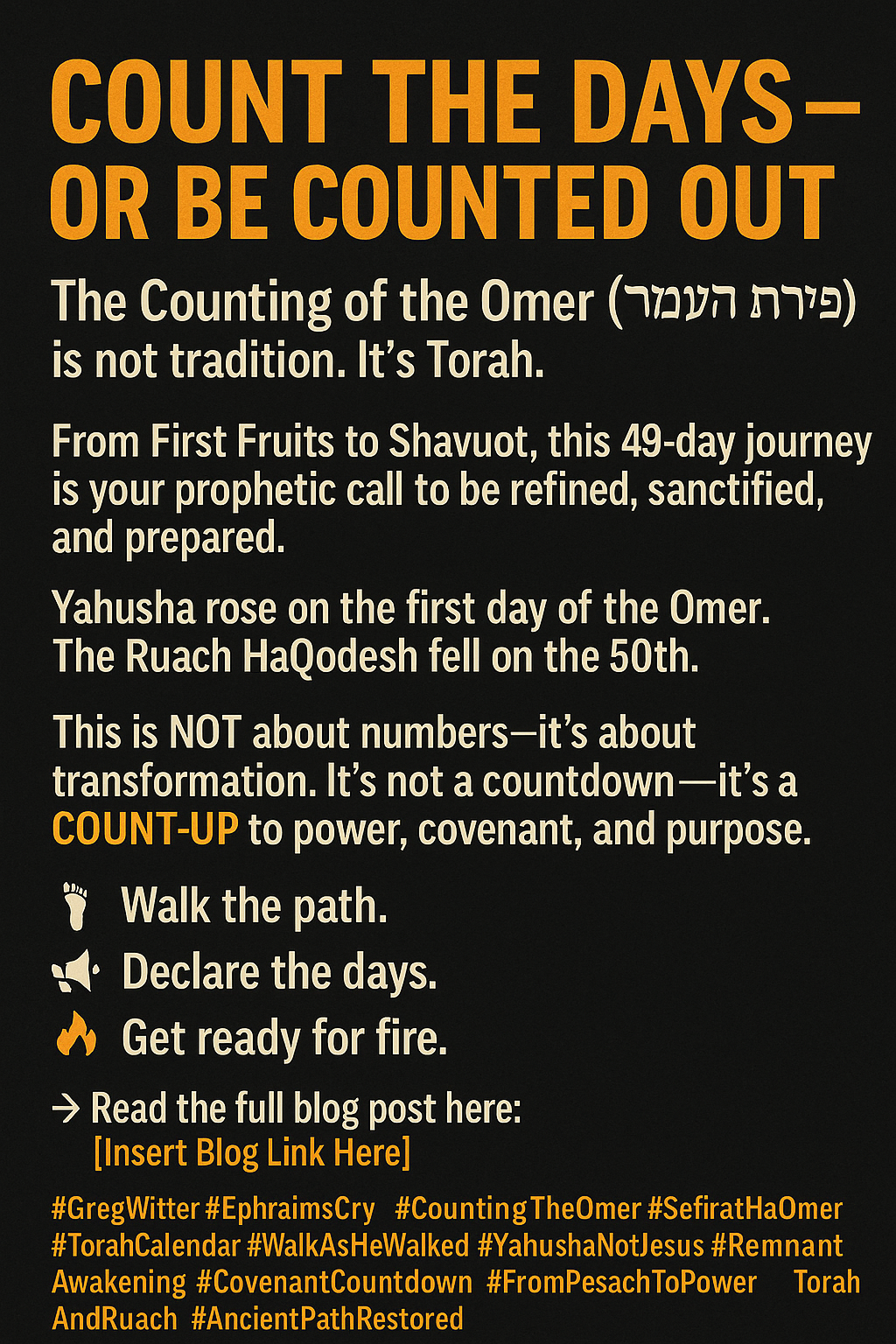
The Counting of the Omer — A Prophetic Journey from Redemption to Covenant Empowerment
✍ By Greg Witter
Ephraim’s Cry | Hebraic Mindset Study Series
Proclaiming the Restoration of Truth — Study ◇ Learn ◇ Apply ◇ Grow ◇ Share ☆ Repeat
📖 Scripture Reading List
Torah
• Wayyiqra (Leviticus) 23:15–16
• Deḇarim (Deuteronomy) 16:9–10
Prophets
• Yeshayahu (Isaiah) 55:6–7
• Yoḥel (Joel) 2:12–13
Writings
• Tehillim (Psalms) 119:1–2
• Mishlē (Proverbs) 4:18
Apostolic Writings
• Ma’asei (Acts) 2:1–4
• 1 Qorintiyim (1 Corinthians) 15:20–23
🔥 Introduction
The Counting of the Omer (Hebrew: Sefirat HaOmer / סְפִירַת הָעֹמֶר) is a Torah-commanded practice rooted in Wayyiqra (Leviticus) 23:15–16, where Yahuah commands His people to count seven full weeks (49 days) beginning from the day after the Sabbath during the Feast of Unleavened Bread, leading up to the 50th day—Shavuot (Feast of Weeks). This period is a prophetic bridge between two major appointed times: Chag HaMatzot (Unleavened Bread) and Shavuot (Pentecost).
This count is not rabbinical tradition—it is covenant Torah instruction.
The Omer count connects the sheaf of barley firstfruits (symbolizing Yahusha’s resurrection) to the wheat harvest of Shavuot (symbolizing the Spirit-empowered people of Yahuah). It is the journey from deliverance to destiny, from redemption to responsibility, from being saved out of bondage to being prepared to carry covenant.
✏ Section 1: What is the Omer?
“And from the morrow after the Sabbath, from the day that you brought the sheaf of the wave offering, you shall count for yourselves: seven completed Sabbaths. Until the morrow after the seventh Sabbath you count fifty days, then you shall bring a new grain offering to Yahuah.” — Wayyiqra (Leviticus) 23:15–16, TS2009
Hebrew & Greek Roots
Omer (עֹמֶר) — “Sheaf; bundle of grain; first fruits of the barley harvest”
Paleo-Hebrew Word Picture
• Ayin (𐤏) = eye
• Mem (𐤌) = chaos/waters
• Resh (𐤓) = head
→ “The eye sees the head emerging from chaos”
Teaching
The Omer was a sheaf of barley harvested at the beginning of the spring season, on the day after the Sabbath during the Feast of Unleavened Bread. This offering was to be waved before Yahuah as a sign of thanksgiving and covenant dedication. Yahusha rose on this very day, fulfilling the prophetic picture as the Firstfruits from the dead (1 Qorintiyim 15:20).
Prophetic Insights
• Yahusha is the Omer offering accepted by Yahuah.
• His resurrection marks the beginning of the 49-day count to Shavuot.
Torah & Prophets Connection
Deḇarim (Deuteronomy) 16:9–10 reaffirms the cutting of the grain and the command to count.
✏ Section 2: How Do We Count?
“Count seven weeks for yourself. Begin to count seven weeks from the time you begin to put the sickle to the grain. Then you shall observe the Feast of Weeks…” — Deḇarim (Deuteronomy) 16:9–10, TS2009
Hebrew & Greek Roots
Safar (סָפַר) — “To count, declare, record, proclaim”
Paleo-Hebrew Word Picture
• Samekh (𐤎) = support
• Peh (𐤐) = mouth
• Resh (𐤓) = head
→ “Support the mouth of the head”
Teaching
Counting the Omer is more than keeping track of days—it is an act of daily declaration. Each day after sunset, the covenant people proclaim, “Today is the ___ day of the Omer.” It is not passive. It is prophetic. Each day is a step forward in covenant growth.
Prophetic Insights
• Declaring the count activates covenant alignment.
• Speaking the day reinforces identity and intention.
Torah & Prophets Connection
Yoḥel (Joel) 2:12–13 urges daily repentance and return. The Omer is the time to return.
✏ Section 3: From Barley to Wheat
“But now Messiah has been raised from the dead, and has become the first-fruits of those having fallen asleep.” — 1 Qorintiyim (1 Corinthians) 15:20, TS2009
Hebrew & Greek Roots
First Fruits (בִּכּוּרִים) — “first ripe produce”
Paleo-Hebrew Word Picture
• Bet (𐤁) = house
• Kaf (𐤊) = open palm
• Resh (𐤓) = head
→ “The first from the house received by the head”
Teaching
Barley, the first crop, symbolizes deliverance. Wheat, the mature crop, represents empowerment and covenant maturity. Yahusha fulfilled the barley offering. The wheat offering represents His people, filled with the Ruach and grounded in Torah.
Prophetic Insights
• Barley is the resurrected Messiah.
• Wheat is the Spirit-filled remnant.
Torah & Prophets Connection
Tehillim (Psalms) 119:1–2 points to the joy of walking blameless in Torah—a fruit of wheat maturity.
✏ Section 4: Transformation Through the Omer
“You shall be to Me a kingdom of priests and a set-apart nation.” — Shemoth (Exodus) 19:6, TS2009
Hebrew & Greek Roots
Qedoshim (קְדוֹשִׁים) — “Set-apart ones”
Paleo-Hebrew Word Picture
• Qof (𐤒) = behind, last
• Dalet (𐤃) = door
• Shin (𐤔) = consume
→ “Those who go through the door are consumed and purified”
Teaching
Each day of the Omer is an opportunity to remove mixture, sin, and compromise. It is about sanctification and readiness. Yahuah delivered us from Egypt, but the Omer is where He delivers Egypt from within us.
Prophetic Insights
• The Omer prepares the bride for Mount Sinai.
• Shavuot is for the clean, not the casual.
Torah & Prophets Connection
Yeshayahu (Isaiah) 55:6–7 calls us to forsake our ways and thoughts in favor of Yahuah’s.
📄 Prophetic Application
You were not redeemed to wander. You were not delivered to delay. You were pulled out of bondage to be prepared for fire. The Omer is your countdown to covenant empowerment. Every day you count, you are declaring: “I am getting ready. I am getting clean. I am getting aligned.”
You are the harvest. And Yahuah is coming to inspect His grain.
🔹 Summary
The Counting of the Omer is not about dates—it is about destiny. From Pesach to Shavuot, this appointed time is Yahuah’s blueprint for transforming slaves into sons, wanderers into warriors, and the redeemed into a remnant prepared for power. Count with your mouth. Walk with your feet. Prepare your heart.
✍ Reflection / Discussion Questions
- What is the true purpose of the Omer count according to Torah?
- How does the Hebrew word safar reveal the prophetic nature of counting?
- What is the connection between the barley and wheat harvests?
- How does Yahusha fulfill the First Fruits offering?
- What should the 49-day journey look like for the remnant believer?
- How is the Omer a preparation for both Torah and Spirit?
- What personal transformation must happen during this appointed time?
✉ Answers to the Reflection / Discussion Questions
- The Omer count is commanded in Torah to mark the journey from redemption to revelation, preparing the people to receive Shavuot.
- Safar means to count, but also to proclaim and declare—it reveals that the count is vocal, active, and prophetic.
- Barley represents deliverance (Yahusha), and wheat represents the matured people (us) prepared for covenant empowerment.
- Yahusha rose on First Fruits as the first sheaf accepted by Yahuah, fulfilling the Omer offering spiritually and prophetically.
- The 49-day journey should be filled with discipline, self-examination, repentance, and increasing devotion.
- The Omer prepares the heart to receive both the Torah at Sinai and the Ruach at Shavuot—truth and power together.
- The believer must be purified, aligned, and ready to carry the covenant boldly and walk in power.
✍ Author Footer
✍ By Greg Witter
Ephraim’s Cry | Hebraic Mindset Study Series
Proclaiming the Restoration of Truth — Study ◇ Learn ◇ Apply ◇ Grow ◇ Share ☆ Repeat
📌 Hashtags
#GregWitter #EphraimsCry #CountingTheOmer #SefiratHaOmer #OmerJourney #FirstFruitsToShavuot #RemnantAwakening #TorahRestoration #YahushaNotJesus #RuachAndTorah #CovenantCountdown #OmerDiscipleship #WalkAsHeWalked
