
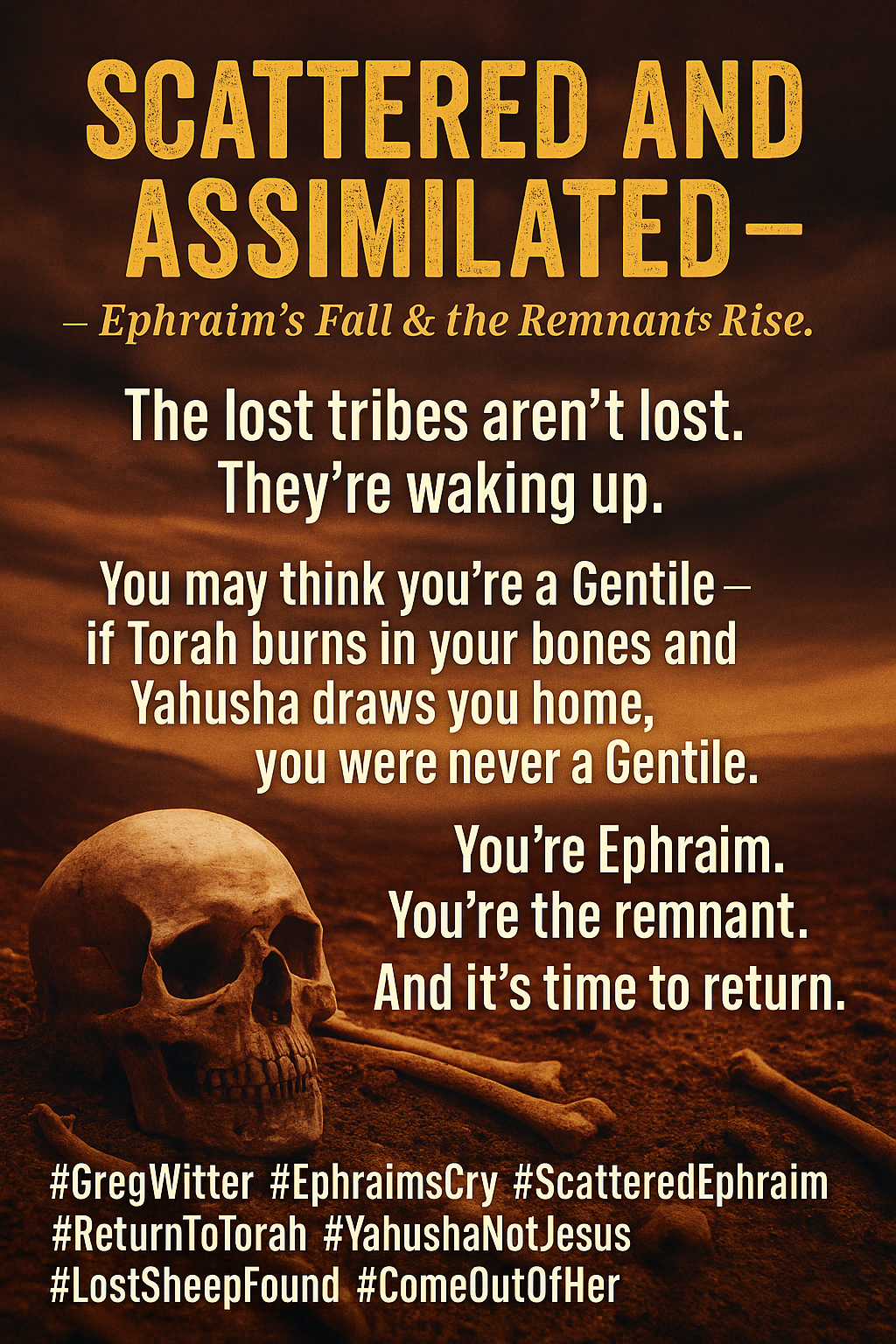
Scattered and Assimilated — The Fall of Ephraim and the Redemption of the Remnant
The Signature of a Broken Covenant, the Prophetic Identity of the Lost, and the Call to Return Before the Judgment Falls
✍ By Greg Witter
Ephraim’s Cry | Hebraic Mindset Study Series
Proclaiming the Restoration of Truth — Study ◇ Learn ◇ Apply ◇ Grow ◇ Share ☆ Repeat
📖 Scripture Reading List
Torah
• Bereshith (Genesis) 12:1–3
• Deḇarim (Deuteronomy) 28:36–64
Prophets
• Hoshĕa (Hosea) 1:9–10
• Yeḥezqĕl (Ezekiel) 37:15–28
Writings
• Tehillim (Psalms) 83:4
• Mishlĕ (Proverbs) 21:16
Apostolic Writings
• Mattithyahu (Matthew) 15:24
• Romiyim (Romans) 11:25–26
🔥Introduction
The fall of the Northern Kingdom is not just a historical event—it is a covenant rupture. Ephraim didn’t merely rebel; they broke the heart of Yahuah by walking away from the Torah, from their identity, and from the covenant that defined them. But their story doesn’t end in rebellion. It becomes the backbone of redemption.
For centuries, these lost tribes have been hidden in plain sight, assimilated into the nations, absorbed into religious systems, and mislabeled as Gentiles. But prophecy never lies. What was scattered will be gathered. What was lost will be found. What was called “not My people” will once again be called “sons of the Living El.”
The question remains: Are you one of them—and will you return before the King does?
📖 Section 1: The Kingdom Divided
“So Israel has been in rebellion against the house of Dawiḏ to this day.” — 1 Melakim (1 Kings) 12:19, TS2009
Hebrew & Greek Roots:
• Ephraim (אֶפְרַיִם) — “Double fruitfulness”; prophetic of increase through scattering
• Schisma (σχίσμα) — “Division, split”; covenantal rupture
Paleo-Hebrew Word Picture:
• Aleph (𐤀) = strength
• Peh (𐤐) = mouth
• Resh (𐤓) = head
• Yod (𐤉) = hand
• Mem (𐤌) = chaos
→ “The strong mouth leads the head’s actions into chaos.”
Teaching:
After Shelomoh’s death, the House of Yisra’ĕl tore in two. Ten tribes followed Yarobʿam and formed the Northern Kingdom. But what looked like civil war was actually a prophetic act of division foretold in Deḇarim (Deuteronomy). Ephraim would be used to multiply and carry the covenant among the nations—but only after falling into idolatry, rebellion, and judgment. The golden calves at Dan and Beth El weren’t just religious errors—they were open defiance against the throne and the Name.
Prophetic Insights:
• Yisra’ĕl divided herself before the world ever scattered her.
• Covenant rebellion begins in the heart long before it reaches the sword.
Torah & Prophets Connection:
• Deḇarim (Deuteronomy) 28:36–37 foretells Yisra’ĕl’s removal from her land for disobedience.
📖 Section 2: Prophetic Warnings Ignored
“Then Yahuah said, ‘Call his name Lo-Ammi, for you are not My people, and I am not for you.’” — Hoshĕa (Hosea) 1:9, TS2009
Hebrew & Greek Roots:
• Lo-Ammi (לֹא עַמִּי) — “Not My people”
• Navi (נָבִיא) — Prophet; speaker for Elohim
Paleo-Hebrew Word Picture:
• Lamed (𐤋) = authority
• Aleph (𐤀) = strength
→ “No authority” — cut off from the strength of the covenant
Teaching:
Yahuah sent prophets like Hoshĕa (Hosea), Amos, and Yeshayahu (Isaiah) to warn Ephraim. These weren’t polite requests for reform—these were declarations of covenant termination if repentance didn’t come. Ephraim was called an adulterous bride, unfaithful to her Husband. But she refused to hear. And so, the sentence was spoken: you are no longer My people. But even in the judgment, Yahuah promised mercy—“where it was said you are not My people, you shall be called sons of the Living El.”
Prophetic Insights:
• Judgment is never the last word for those who belong to the covenant.
• But it is always the next word for those who forget it.
Torah & Prophets Connection:
• Deḇarim (Deuteronomy) 29:24–28 warns all nations will witness Yisra’ĕl’s desolation for forsaking the covenant.
📖 Section 3: Scattering Through Assyrian Captivity
“In the ninth year of Hoshĕa, the sovereign of Ashshur took Shomeron and exiled Yisra’ĕl to Ashshur…” — 2 Melakim (2 Kings) 17:6, TS2009
Hebrew & Greek Roots:
• Zarah (זָרָה) — “To scatter, disperse”
• Diaspora (διασπορά) — “Scattering of seed”
Paleo-Hebrew Word Picture:
• Zayin (𐤆) = weapon
• Resh (𐤓) = head
• Hey (𐤄) = behold
→ “Behold, the weapon strikes the head.”
Teaching:
In 722 BCE, the Assyrians carried out what Yahuah had warned: the land vomited out the rebellious tribes. Deportation wasn’t just punishment—it was prophetic repositioning. Yisra’ĕl was scattered like seed into the nations, her identity shattered. She became as the Gentiles—but not forgotten.
Prophetic Insights:
• The exile of Ephraim was not destruction. It was sowing.
• Yahuah only sows when He plans to harvest.
Torah & Prophets Connection:
• Deḇarim (Deuteronomy) 28:64 — Yahuah will scatter them from one end of the earth to the other.
📖 Section 4: Becoming Like the Nations
“You are not My people… but it shall be said to them, ‘You are sons of the living El.’” — Hoshĕa (Hosea) 1:10, TS2009
Hebrew & Greek Roots:
• Goyim (גּוֹיִם) — “Nations”; uncovenanted peoples
• Ethnos (ἔθνος) — “Gentiles”; those outside the covenant
Paleo-Hebrew Word Picture:
• Gimel (𐤂) = lift up
• Waw (𐤅) = secure
• Yod (𐤉) = work
• Mem (𐤌) = chaos
→ “Lifted up and secured to chaos through their works”
Teaching:
The tragedy of the Northern Kingdom was not just exile—it was identity loss. They became “as the Gentiles.” Their children spoke foreign languages. Their worship turned pagan. They were seen as strangers by Yahudah and labeled unclean. But Yahusha saw them as what they were: lost sheep. Not Gentiles by birth, but Israelites by blood—estranged, not erased.
Prophetic Insights:
• You can forget who you are.
• But Yahuah never forgets who He made you to be.
Torah & Prophets Connection:
• Tehillim (Psalms) 83:4 — “Let the name of Yisra’ĕl be remembered no more.”
📖 Section 5: The Promise of Restoration
“And I shall make them one nation in the land… and one sovereign shall be sovereign over them all.” — Yeḥezqĕl (Ezekiel) 37:22, TS2009
Hebrew & Greek Roots:
• Shuv (שׁוּב) — “Return, restore”
• Apokatastasis (ἀποκατάστασις) — “Restoration, reconstitution”
Paleo-Hebrew Word Picture:
• Shin (𐤔) = consume
• Waw (𐤅) = secure
• Bet (𐤁) = house
→ “To consume and secure the house”
Teaching:
The dry bones in Yeḥezqĕl’s (Ezekiel’s) valley are Ephraim. Dead. Forgotten. But not beyond resurrection. Yahuah promised to gather them, breathe on them, and unite them again with Yahudah. One house. One King. One Torah. One covenant. The time is coming, and the wind is already blowing.
Prophetic Insights:
• The bones are not dry forever.
• The two sticks will become one.
Torah & Prophets Connection:
• Yeḥezqĕl (Ezekiel) 37 and Yirmeyahu (Jeremiah) 31 confirm the reunification of all Yisra’ĕl.
⚔️ Prophetic Application
If you’ve spent your life thinking you were a Gentile… if your heart is drawn to Torah… if the Name of Yahusha has stirred something ancient in you—you may be one of them. One of the lost. One of the scattered. One of the remnant.
Yahuah is not restoring religion. He’s restoring identity. Ephraim is rising. Yahudah is watching. The time is short. Return to the covenant. Take hold of the Name. Walk the path your ancestors abandoned.
🧬 Blog Summary
This blog revealed the rebellion and scattering of the Northern Kingdom, the prophetic identity loss of Ephraim, and the mission of Yahusha to regather and restore the lost tribes through covenant, Torah, and the Name. The remnant is no longer hidden—it is awakening to its identity and preparing for the return of the King.
Stand strong. Walk in truth. Proclaim the Name. Walk as Messiah walked.
📊 Reflection / Discussion Questions
- How did Ephraim’s rebellion result in covenant loss, and what made it more than just a political division?
- In what ways has the modern church system mirrored Ephraim’s idolatry and identity loss?
- What is the prophetic significance of being labeled “Lo-Ammi” and how does that still apply today?
- How does the Assyrian exile serve as a warning to the remnant today about compromise and judgment?
- What practical evidence might identify someone today as a descendant of scattered Ephraim?
- What does the uniting of the two sticks in Yeḥezqĕl (Ezekiel) 37 reveal about Yahuah’s ultimate plan for His people?
- How does Yahusha’s mission to the “lost sheep of the house of Yisra’ĕl” directly connect to Torah restoration and identity?
📖 Answers to Reflection / Discussion Questions
- Ephraim’s rebellion was covenantal, not just civil. They rejected Yahuah’s authority, abandoned Torah, and instituted idolatrous worship. The division marked a fracture in spiritual identity and brought judgment through exile.
- Modern Christianity mirrors Ephraim’s rebellion by rejecting Torah, renaming the Messiah, and embracing syncretized worship. They have forgotten the covenant and wear the mask of faith without the walk of obedience.
- “Lo-Ammi” means being cut off from Yahuah’s covenant. It applies today to those who live in rebellion to His Torah while claiming His Name. Covenant identity cannot coexist with lawlessness.
- The Assyrian exile is a warning to today’s remnant—Yahuah keeps His word. Disobedience leads to scattering, silence, and shame. Compromise always precedes captivity.
- Those who are awakened to Torah and the true Name often carry Ephraim’s DNA. This is not genetic curiosity—it’s prophetic restoration. The remnant rises when the Spirit calls.
- Yeḥezqĕl’s (Ezekiel’s) vision of the two sticks confirms Yahuah’s purpose: to restore one house, one Torah, and one Shepherd. Division will not last. Reunification is guaranteed.
- Yahusha’s mission was not universal religion—it was covenant restoration. He came for the lost sheep of Yisra’ĕl, to bring them back to Torah, identity, and truth. His blood seals the covenant they forgot.
✍ Author Footer
✍ By Greg Witter
Ephraim’s Cry | Hebraic Mindset Study Series
Proclaiming the Restoration of Truth — Study ◇ Learn ◇ Apply ◇ Grow ◇ Share ☆ Repeat
📛 Hashtags
#GregWitter #EphraimsCry #ScatteredEphraim #ComeOutOfHer #ReturnToTorah #YahushaNotJesus #RemnantAwakening #NorthernKingdom #TwoHouseRestoration #LostSheepFound #SetApartIdentity #TorahObedience #CovenantTruth #WalkAsHeWalked #RejectChurchianity
